
Adjacent Satellite Interference (ASI) Types & mitigation
Advertisement
Above the Earth, there are two primary orbits housing LEO and GEO satellites. As more satellites are being launched for various applications, managing RF interference becomes very critical. One of the most challenging parameter is Adjacent Satellite Interference (ASI). Let us understand its types and how to mitigate its effect in both uplink and downlink.
What is Adjacent Satellite Interference (ASI)
It is the phenomenon where a satellite ground station (Earth Station) inadvertently transmits radio frequency (RF) energy to, or receives unwanted RF energy from, a satellite that is physically located close to its intended target satellite.
Why does ASI happen ?
It is primarily product of two factors, orbital crowding and antenna physics.
- Orbital crowding : In the GEO arc, satellites are parked in specific slots. To maximize the number of satellites, regulatory bodies space them very closely together; typically only 2 degrees or 3 degrees apart from the perspective of an antenna on Earth.
- Antenna side lobes : No antenna focuses 100% of its energy into a perfectly straight line. Some energy always leaks out at slight angles. These leakage patterns are called side lobes. If a ground antenna is too small, poorly manufactured, or misaligned, its main lobe becomes wider and its side lobes become stronger, causing the signal to overlap with the 2 degree spacing of neighboring satellites.
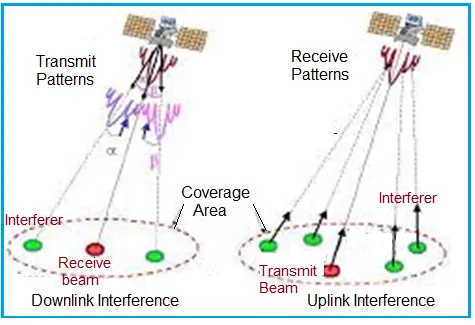 Image Courtesy : researchgate.net
Types of ASI
There are two types of ASI, categorized by direction of the transmission.
Uplink ASI : This occurs when a ground station is transmitting a signal up to its intended satellite (Satellite A), but because of wide beamwidth or high side-lobe emissions, a portion of that signal hits the neighboring satellite (Satellite B).
Downlink ASI : This occurs when a ground station is “listening” for a signal from its intended satellite (Satellite A). However, because the ground antenna’s “field of hearing” is too wide, it simultaneously picks up the downlink transmissions from the neighboring Satellite B.
Mitigation of ASI
To prevent ASI from rendering satellite communication useless, the industry relies on strict engineering and regulatory frameworks.
- Antenna size : Larger antennas naturally produce narrower, more tightly focused beams. A 2.4-meter VSAT dish will have much less ASI risk than a tiny 0.6-meter dish.
- Off-axis EIRP density limits : Regulators dictate exactly how much power a ground station is legally allowed to radiate at specific angles away from its center target. This is known as an “Off-Axis EIRP Mask.” If an antenna’s side lobes exceed this mask, it cannot legally transmit.
- Advanced modulation & Spread spectrum : Using techniques like Direct Sequence Spread Spectrum, signals can be transmitted at very low power densities (i.e. often below the noise floor), minimizing the impact of ASI on neighboring satellites.
- Dynamic ASI in LEO : In modern LEO mega constellations (like Starlink or OneWeb), satellites are constantly moving. ASI happens dynamically when a LEO satellite passes exactly in line between a ground station and a higher GEO satellite. Systems now use predictive software to temporarily mute or hand off beams during these “inline events” to prevent ASI.
References
- ITU Radio Regulations (International Telecommunication Union), Article 21 and Article 22
- FCC Part 25 (U.S. Federal Communications Commission), 47 CFR 25.218 and § 25.222-228.
- Satellite Communications Systems Engineering by Gerard Maral, Michel Bousquet, Zhili Sun.
Continue Learning Interference & Mitigation Techniques
- Understanding Interference and its Types
- ISI vs co-channel vs adjacent channel RF interference : Key differences
- Self-Interference Cancellation (SIC) in 5G
- Femtocell Interference: Causes, Effects, and Mitigation
- SAIC (Single Antenna Interference Cancellation) in GSM
Continue Learning Satellite Communication Technology
- Satellite Communication Basics Tutorial
- GEO Vs. LEO Vs. MEO Satellite Types
- Apogee and Perigee in Satellite Communication
- Satellite Capacity Allocation Types
- Satellite Frequency Bands
- Satellite Transponder Components & its function
- Satellite Bus vs Payload : Understand functions
- Satellite Ground Station Basics
- Satellite System Security Mechanisms & Standards
- Satellite Parking Lot Concepts and Procedures
- Satellite Launching Procedure and Processes
- Telemetry, Tracking and Command (TTC) in Satellite System