
What is RF Transceiver: Design & specifications explained
Advertisement
An RF transceiver is a combined electronic unit containing both a transmitter and a receiver, allowing two way wireless communication. Its core design includes oscillators, mixers, low noise amplifiers (LNAs), and power amplifiers (PAs). Crucial specifications to evaluate include receiver sensitivity, transmitter output power, noise figure, and dynamic range, ensuring seamless data transmission across cellular and Wi-Fi networks.
An RF transceiver integrates both transmission and reception functionalities into a single unit, facilitating efficient wireless communication. These devices are fundamental to various systems, including Wi-Fi, LTE, and Bluetooth.
Definition
“Transceiver” is the term used for a device that houses both a transmitter and a receiver in a single module. Such a device, which transmits and receives Radio Frequency (RF) signals, is called an RF Transceiver.
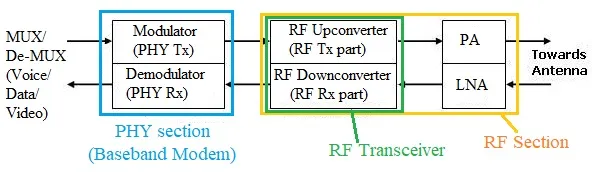
Mostly, an RF Transceiver is positioned between the Baseband MODEM and the PA/LNA in a wireless communication system. PA stands for Power Amplifier, and LNA stands for Low Noise Amplifier. The Baseband Modem houses chipsets for various analog/digital modulation techniques and ADC/DAC chips.
Applications
RF Transceivers are essential whenever wireless communication is involved. Their primary application lies in making information, such as voice, data, or video, suitable for transmission over a wireless medium.
Specifically, an RF Transceiver is used to convert Intermediate Frequency (IF) signals to RF frequencies and vice versa. It is commonly used in:
- Satellite communication
- Radio transmission and reception
- Television signal transmission and reception
- WiMAX/WLAN/Zigbee/LTE networks
RF Transceiver Design
RF Transceivers are typically constructed from RF mixers, amplifiers, pads, and other RF components using microstrip technology. The transmitter portion is often referred to as an RF Up converter, while the receiver portion is called an RF Down converter.
To understand RF transceiver basics, it’s helpful to delve into the design aspects of RF frequency converters
RF Transceiver Technical Specifications
There are numerous parameters associated with RF Transceivers. We’ll discuss a few of the key ones:
-
Transmitter Part: Input and output frequency range, conversion gain, gain flatness, gain adjustment, spurious and harmonics output, 1dB compression point, frequency stability.
-
Receiver Part: Input and output frequency range, conversion gain, gain flatness, gain adjustment, noise figure, spurious output, Image rejection, frequency stability, adjacent and non-adjacent channel rejection.
Summary
The RF transceiver is the foundational hardware required for full duplex, two way wireless communication in mobile devices and IoT applications. Evaluating core specifications like noise figure and receiver sensitivity is critical for designing highly efficient radio hardware.