
What is RF Transceiver: Advantages and Disadvantages
Advertisement
An RF transceiver is an electronic device that integrates both a radio frequency transmitter and receiver into a single unit for wireless communication. Its advantages include compact design, lower power consumption, and simplified system integration, while its disadvantages include design complexity, interference management, and thermal considerations.
Application note of RF Transceiver used in VSAT & its selection guide
The RF transceiver sits between the modem (modulator-demodulator) and the RF Power Amplifier (PA)/RF Low Noise Amplifier (LNA). It finds extensive use in wireless, satellite, and microwave communication systems. Its primary role is to carry modulated voice, data, or video signals on an RF carrier, tailored to specific system requirements.
Various RF transceivers are available for both indoor and outdoor wireless applications. Indoor systems include technologies like WiFi, Zigbee, and Z-Wave. Outdoor systems encompass GSM, CDMA, LTE, and 5G NR.
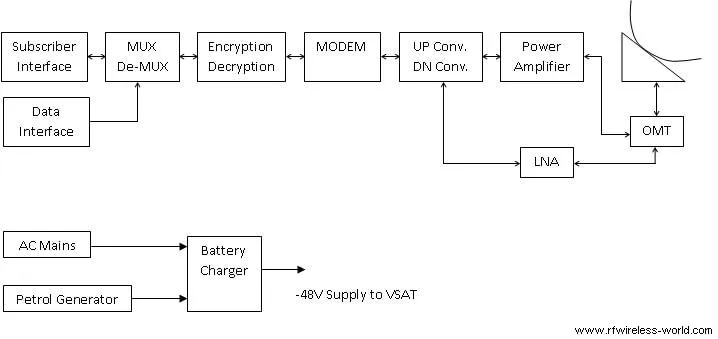
The figure illustrates the position of an RF transceiver within a C-band VSAT system, commonly used in satellite communication setups.
An RF transceiver consists of two main parts:
- RF Up-converter (UC): Converts an Intermediate Frequency (IF) signal to an RF signal.
- RF Down-converter (DC): Converts an RF signal to an IF signal.
For instance, a C-band transceiver might convert a 70 +/- 18 MHz signal to 5925-6425 MHz during the uplink and convert 3700-4200 MHz back to 70 +/- 18 MHz during the downlink.
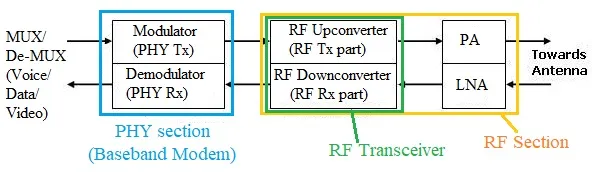
The following specifications are typically considered when selecting an RF transceiver:
- Frequency Range (Transmit and Receive)
- Conversion Gain
- Gain Flatness
- Gain Adjustment
- Noise Figure
- 1dB Compression Point
- Spurious Frequencies
- Harmonic Frequencies
- Image Rejection
- Frequency Stability
- Adjacent and Non-Adjacent Channel Rejection
Benefits or Advantages of RF Transceivers
- Integration: They can be easily integrated into diverse wireless systems and devices. (It’s crucial to check the frequency range of different RF transceivers to choose the appropriate one for a given application.)
- Combined Functionality: RF transceivers support both transmit and receive functions within a single module, saving cost and space.
- Frequency Band Support: Different RF transceivers operate on various frequency bands. This allows a transceiver with a specific band to reject other frequencies in congested RF environments, preventing interference with other systems.
- Frequency Selection: Frequencies can be selected based on the step size (e.g., 500 KHz, 1 MHz) of the synthesizer used in the RF transceiver design.
- Easy Interfacing: RF transceivers can be easily interfaced with LNAs, PAs, and Modem ICs or modules.
Drawbacks or Disadvantages of RF Transceivers
- Power Consumption: RF transceivers generally require medium to high power, making some unsuitable for battery-powered applications.
- Design Complexity: Designing RF transceivers, especially for small devices, is a complex process.
- Regulatory Compliance: RF transceivers must comply with regulatory transmission requirements regarding power, frequency, and other factors.
Summary
RF transceivers form the core of modern wireless communication systems by enabling efficient transmission and reception of radio signals in a compact architecture. Their integration advantages improve device performance and reduce hardware size, although optimization for power, noise, and interference remains essential.
Continue Learning Frequency Converters : Upconverters & Downconverters
- Up & Down Frequency Converter Design Using Discrete Components
- C-Band RF Transceiver Design For VSAT
- Millimeter Wave Up/Down Converter Design
- DUC vs DDC: Understanding Digital Up-Conversion and Digital Down-Conversion
- RF Mixer Basics Tutorial
- Mixer Isolation: LO, RF, and IF