
What is MMIC & its biasing: 5 Advantages and Disadvantages
Advertisement
A Monolithic Microwave Integrated Circuit (MMIC) integrates microwave components such as amplifiers, mixers, and oscillators onto a single semiconductor substrate. MMICs are widely used in radar, satellite communication, and 5G systems. Advantages include compact size and high reliability, while disadvantages include design complexity and higher development costs.
Features and biasing of MMIC
The Monolithic Microwave Integrated Circuit (MMIC) is developed using various fabrication techniques such as diffusion, ion implantation, epitaxial growth, lithography, photo etching, and deposition.
All the components, active and/or passive, are formed and processed simultaneously on a single dielectric substrate using these deposition techniques.
The different materials used for its construction include GaAs, InP, GaN, SiGe, etc.
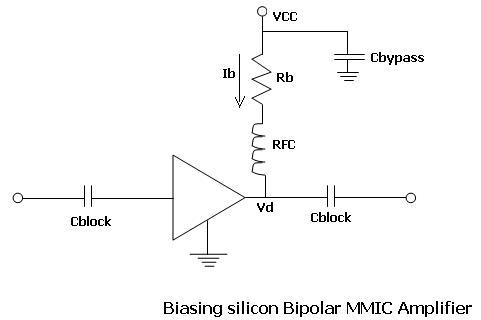
Various microwave circuits are formed using the MMIC concept, which includes amplifiers, mixers, switches, and so on.
Figure 1 depicts the biasing configuration of a bipolar MMIC type.
Benefits or Advantages of MMIC
- Due to its construction, component density is higher. Hence, thousands of devices can easily be fabricated in a single MMIC simultaneously during fabrication.
- Due to higher component density during fabrication, the cost of fabrication is lower. Hence, the overall MMIC cost is less.
- There are minimal mismatches in the MMIC between components.
- The signal delay is minimal due to shorter distances between the components on a MMIC.
- MMICs do not have any wire bond reliability issues.
Drawbacks or Disadvantages of MMIC
- The overall performance of MMIC is compromised as optimal materials cannot be used during manufacturing for each element individually.
- Power handling capacity is lower as proper heat transfer materials are not used in the fabrication of MMIC.
- Trimming adjustments are impossible or difficult to implement. Hence, troubleshooting or rework is impossible.
- The device-to-chip area ratio is unfavorable in the semiconductor material used in MMIC fabrication.
- The tools are prohibitively expensive for the fabrication of small quantities of MMICs.
Summary
MMIC technology integrates multiple microwave functions onto a single chip. Advantages include miniaturization, performance consistency, and reliability, while disadvantages include manufacturing complexity and higher design expenses.
Advertisement


