
What is Microbolometer : Advantages and Disadvantages
Advertisement
A microbolometer is an uncooled thermal sensor used in infrared cameras to detect heat radiation and create thermal images without requiring visible light. It is widely used in surveillance, industrial inspection, firefighting, and medical diagnostics. Advantages include compact design and low power consumption, while disadvantages include lower sensitivity and resolution compared to cooled infrared detectors.
Microbolometer Working, Structure & features
- The microbolometer is a specialized bolometer, crafted as an uncooled thermal sensor.
- It serves as a detector in thermal cameras or thermal imaging equipment.
- Figure 1 depicts a cross-sectional view of a microbolometer with different layers. It consists of an infrared absorber, a reflective layer (e.g., titanium mirror), and a readout circuit or silicon substrate.
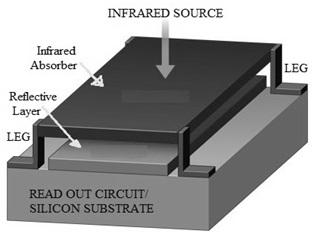
- When infrared radiation strikes the detector material, it heats up and consequently changes its electrical resistance.
- This change in resistance is measured and used to create an image.
- Typically, some amount of light passes through the absorbing layer. This is reflected back by a reflector to ensure the greatest possible absorption can be achieved. This allows for the production of a stronger signal using the microbolometer.
- Microbolometer arrays come in various sizes, such as 320 x 240 pixels, 160 x 120 pixels, 640 x 480 pixels, or 1024 x 768 pixels.
Benefits or Advantages of Microbolometers
- It does not require cooling, unlike other IR detecting equipment. Hence, it can be operated at room temperature.
- They are smaller and lightweight.
- They consume less power compared to cooled detector thermal imaging devices.
- They have a higher MTBF (Mean Time Between Failures) value, and therefore a longer lifespan.
- Microbolometers are less expensive compared to cooled detector-based cameras.
Drawbacks or Disadvantages of Microbolometers
- The sensitivity of this type of thermal detector is lower compared to photon detectors or cooled thermal imagers.
- Response time is longer compared to photon detectors.
- They cannot be used for multi-spectral or high-speed infrared (IR) applications.
- They cannot match the resolution in comparison to cooled semiconductor-based methods.
- They have higher noise compared to cooled semiconductor methods, which may interfere with the desired signal significantly.
Summary
Microbolometers are thermal imaging sensors that detect infrared radiation without cooling systems. Advantages include affordability, compact size, and low power operation, while disadvantages include limited sensitivity, slower response, and lower image quality than cooled detectors.
Advertisement


