
What is LDMOS Transistor : Advantages and Disadvantages
Advertisement
LDMOS (Laterally Diffused Metal Oxide Semiconductor) transistors are widely used in RF power amplifiers for cellular base stations, broadcasting, and industrial applications. They provide high power efficiency and excellent linearity. Advantages include cost-effective high-power performance, while disadvantages include limited operation at very high microwave frequencies.
LDMOS Structure
In the realm of RF/Microwave applications, two primary types of power MOSFETs are commonly used: DMOS and LDMOS. Each possesses a unique structure and employs distinct semiconductor processes. These devices are manufactured in both NMOS (n-type MOSFET) and PMOS (p-type MOSFET) variants.
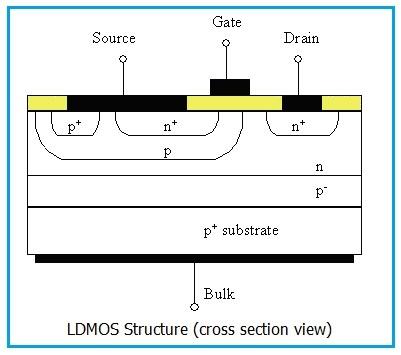 LDMOS structure
LDMOS is primarily a lateral, surface-effect device. The channel current in an LDMOS is controlled by the vertical electric field (E), induced by the gate, and the lateral field existing between the Source (S) and Drain (D).
In LDMOS devices, the channel is defined by three key parameters: gate length, drain diffusion, and source diffusion. Figure 1 (shown above) illustrates a cross-sectional view of the LDMOS structure.
Benefits or Advantages of LDMOS
- High-Frequency Operation: Operates effectively up to 2.2 GHz, making it suitable for cost-effective Power Amplifier solutions.
- Linear Amplification: Demonstrates excellent performance in class-AB operation, enabling the design of linear amplifiers with higher gain and improved efficiency.
- Ruggedness: Delivers highly robust devices with good VSWR (Voltage Standing Wave Ratio).
- Thermal Stability: Exhibits consistent thermal behavior.
- Broadband Applications: Well-suited for broadband applications below 1 GHz.
- High Power Delivery: Capable of delivering high power outputs up to 1.5 GHz.
- High PAPR Capability: Ideal for systems (CDMA, WCDMA) requiring higher crest factors due to its high PAPR (Peak to Average Power Ratio) capability.
Drawbacks or Disadvantages of LDMOS
- Current Drift: Current drift due to elevated temperature can be a concern. This issue is being addressed in newer generations of LDMOS devices.
- Reliability Concerns: Layout and packaging, in conjunction with gold top metallization and gold bonding wires (a well-established practice for RF power semiconductors), are critical factors in ensuring the long-term reliability of the device, and consequently, the RF power amplifier and basestation.
- Critical Design Factors: To ensure long-term reliability, careful attention must be paid to layout, packaging, and the use of gold top metallization in LDMOS device design.
Summary
LDMOS transistors are popular RF power devices for wireless infrastructure. Advantages include efficiency and reliability, while disadvantages include frequency limitations compared to GaN technologies.
Advertisement


