
Pulse Interval Modulation (PIM): Basics, Advantages, and Disadvantages
Advertisement
This article explores the basics of Digital Pulse Interval Modulation (PIM), its advantages, disadvantages, and a comparison with other modulation techniques like PCM and PPM. PIM, along with other pulse modulation schemes, is often used in Free Space Optics (FSO) communication systems to improve average power efficiency, even if it means using more bandwidth.
The following pulse modulation schemes are employed which can provide higher average power efficiency at the expense of higher bandwidth requirement:
- On-Off Keying (OOK)
- Pulse Position Modulation (PPM)
- Pulse Interval Modulation (PIM)
OOK Modulation
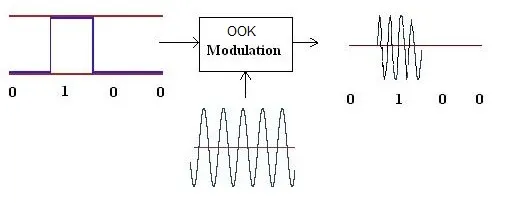 OOK modulation
OOK, or On-Off Keying, is a simple modulation scheme based on intensity modulation. In this scheme, a ‘0’ is represented by zero intensity, and a ‘1’ is represented by a positive intensity. For more details, refer to the difference between OOK vs ASK vs FSK.
PPM Modulation
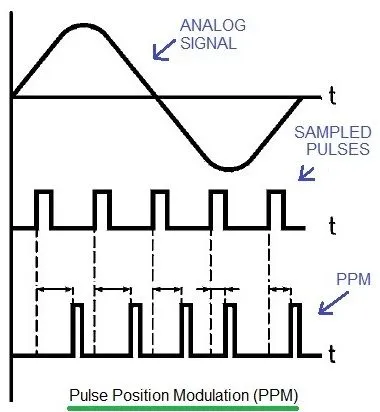 PPM modulation
PPM stands for Pulse Position Modulation. In PPM, the relative position of a pulse is proportional to the amplitude of the modulating signal. This is similar to phase modulation (PM). See advantages and disadvantages of pulse modulation schemes such as PAM vs PWM vs PPM for a comprehensive view.
What is Pulse Interval Modulation (PIM)?
In PIM, data bits (typically in pairs) are encoded as the number of time intervals between successive pulses, as shown in the figure below.
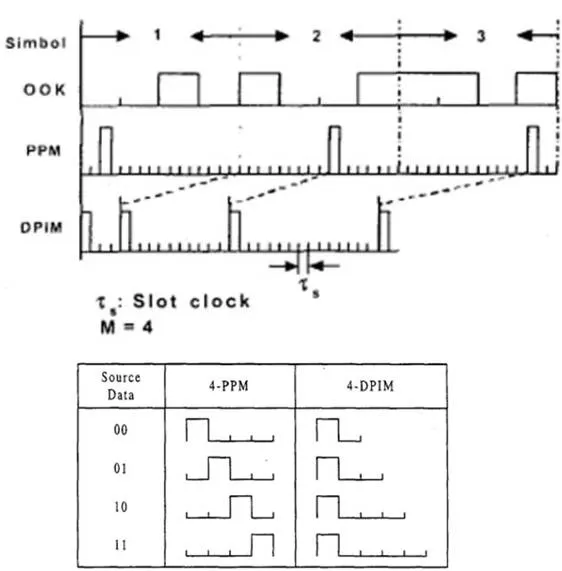 PIM , Pulse Interval Modulation. Image Courtesy: slideplayer.com
The figure above illustrates a digital PIM waveform. It also presents a table showing how digital bit pairs are represented by different pulse interval durations.
Benefits (Advantages) of Pulse Interval Modulation (PIM)
The following are the advantages of Pulse Interval Modulation (PIM):
- High Average Power Efficiency (APE): PIM offers higher APE compared to OOK modulation.
- No Symbol-Level Synchronization Required: This simplifies the receiver design.
- High Information Capacity: PIM can transmit more data within a given timeframe.
- Simple Receiver Architecture: PIM receivers can be relatively simple to implement.
Drawbacks (Disadvantages) of Pulse Interval Modulation (PIM)
The main disadvantage of Pulse Interval Modulation (PIM) is:
- Lower APE than PPM: PIM has a lower Average Power Efficiency (APE) compared to PPM modulation.
Comparison Between PIM, PCM, and PPM
The following points summarize the comparison between PIM, PCM, and PPM modulation techniques:
-
PCM (Pulse Code Modulation): In PCM, the analog signal (e.g., speech) is sampled and converted directly into a multi-bit digital code using an Analog-to-Digital converter (ADC). Each sample is represented by a digital binary value. For more information, read more on advantages and disadvantages of PCM modulation.
-
PPM (Pulse Position Modulation): In PPM, the position of the pulse relative to a reference point represents the amplitude of the modulating signal.
-
PIM (Pulse Interval Modulation): In PIM, data bits (usually pairs) are encoded as the number of time intervals between successive pulses, as shown in the table earlier.
Continue Learning Modulation Types
- AM Vs. FM Vs. PM : Difference between Analog Modulation Techniques
- ASK Vs. FSK Vs. PSK : Difference between Digital Modulation Techniques
- PAM Vs. PWM Vs. PPM : Difference between Pulse Modulation Techniques
- BPSK Vs. QPSK : Key Differences
- 16-QAM Vs. 64-QAM Vs. 256-QAM : Key Differences
- 512-QAM Vs. 1024-QAM Vs. 2048-QAM Vs. 4096-QAM
- 4096QAM Modulation Used in Wi-Fi 7
- MSK Vs. GMSK : Modulation Technique used in GSM
- LORa Modulation Used in LoRaWAN
- 10% ASK & 100% ASK Modulation used in NFC
- OOK Vs. VPPM Vs. CSK : Visible Light Communication (VLC) Modulation Techniques
- QPSK Vs. OQPSK Vs. PI/4 QPSK
- PAM4 Modulation Used in Gigabit Ethernet
- CCK Vs. DSSS Vs. OFDM Used in WLAN (Wi-Fi) Standards