
What is Pulse Density Modulation (PDM): 5 Advantages and Disadvantages
Advertisement
Pulse Density Modulation (PDM) is a digital modulation technique in which signal amplitude is represented by the density of pulses over time. It is widely used in digital microphones, audio processing, and embedded systems because of its simple implementation and high-quality digital audio conversion.
Key Features of Pulse Density Modulation and waveforms
Introduction: Pulse Density Modulation (PDM) is a technique where a sampled signal is represented by a stream of single bits. It’s often described as “oversampled 1-bit audio.” PDM essentially converts an analog signal into a binary signal.
Unlike Pulse Code Modulation (PCM), which maps specific amplitude levels to codewords with different weights, PDM represents amplitude levels through the relative density of pulses.
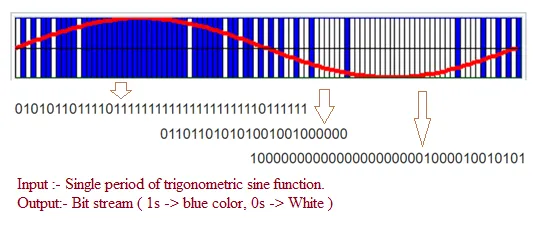
The figure above illustrates a pulse density modulated output bitstream. A ‘1’ corresponds to a pulse with positive polarity, while a ‘0’ corresponds to a pulse with negative polarity.
This can be expressed mathematically as:
x[n] = - A (-1) a[n]
Where:
- x[n] is the bipolar stream with values of either -A or +A
- a[n] is the binary stream with values of either ‘0’ or ‘1’
PDM is essentially a high-sampling-rate, single-bit digital system. Let’s break down how a PDM signal is generated, transmitted, and converted back:
- A PDM modulator converts analog audio into PDM’s 1-bit format.
- A PDM demodulator converts the PDM 1-bit signal back into analog audio.
A PDM microphone typically consists of:
- An electret microphone element
- An analog preamplifier
- A PDM modulator
- Interface logic
The analog signal is first amplified and sampled at a high rate before being quantized in the PDM modulator.
Benefits (Advantages) of Pulse Density Modulation
- Low Noise: Uses a digital form of signal to represent analog audio, leading to a lower noise output.
- Immunity to Interference: Less susceptible to interfering signals.
- Low-Cost Implementation: Suitable for cost-effective implementations where analog audio is converted into digital form (mono or stereo) over a clock/data pair.
- Simple Analog Conversion: Conversion from PDM signal back to analog is straightforward, requiring only a simple low-pass filter.
- High Audio Performance: With appropriate design, extremely high audio performance is achievable.
Drawbacks (Disadvantages) of Pulse Density Modulation
- Poor Representation: The one-bit representation is less detailed compared to multi-point PCM modulation.
- Modulator Overload: The PDM modulator can become overloaded if the input level exceeds the defined maximum, resulting in poor noise performance.
- Converter Requirements: Good performance 1-bit A/D and D/A converters are needed for both the PDM modulator and demodulator.
- Delta Modulation Drawbacks: PDM uses delta-sigma modulation to encode the analog signal, inheriting the same drawbacks as delta modulation.
Summary
Pulse Density Modulation (PDM) represents analog signals by varying pulse density rather than amplitude. It is widely used in digital audio systems and MEMS microphones.
Continue Learning Modulation Types
- AM Vs. FM Vs. PM : Difference between Analog Modulation Techniques
- ASK Vs. FSK Vs. PSK : Difference between Digital Modulation Techniques
- PAM Vs. PWM Vs. PPM : Difference between Pulse Modulation Techniques
- BPSK Vs. QPSK : Key Differences
- 16-QAM Vs. 64-QAM Vs. 256-QAM : Key Differences
- 512-QAM Vs. 1024-QAM Vs. 2048-QAM Vs. 4096-QAM
- 4096QAM Modulation Used in Wi-Fi 7
- MSK Vs. GMSK : Modulation Technique used in GSM
- LORa Modulation Used in LoRaWAN
- 10% ASK & 100% ASK Modulation used in NFC
- OOK Vs. VPPM Vs. CSK : Visible Light Communication (VLC) Modulation Techniques
- QPSK Vs. OQPSK Vs. PI/4 QPSK
- PAM4 Modulation Used in Gigabit Ethernet
- CCK Vs. DSSS Vs. OFDM Used in WLAN (Wi-Fi) Standards