
What is Photodiode: 5 key Advantages and Disadvantages
Advertisement
A photodiode is a semiconductor light sensor that converts incident light into electrical current through the photoelectric effect. It provides fast response, high sensitivity, and reliable optical detection, making it widely used in fiber optic communication, medical devices, industrial automation, and consumer electronics.
Photodiode symbol & its working principle
A photodiode is a semiconductor device that acts as a photodetector, converting light into either current or voltage. It’s typically operated in reverse bias. The electric field across the p-n junction sweeps mobile charge carriers to their respective majority sides, forming a depletion region. This barrier prevents the flow of majority carriers, allowing only minority carriers to flow, resulting in a leakage current.
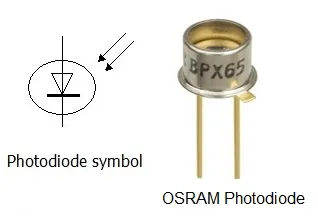
Figure 1: Photodiode symbol and a photodiode from OSRAM.
Advantages of Photodiode
- Better Frequency Response: Photodiodes can respond quickly to changes in light intensity, making them suitable for high-speed applications.
- Linearity: The output current of a photodiode is linearly proportional to the input light intensity over a wide range.
- Low Noise: Compared to other photodetectors, photodiodes generate less noise, resulting in cleaner signals.
- Variable Resistance: Can be used as a variable resistance device, where resistance changes based on the light it receives.
- High Light Sensitivity: Photodiodes are very sensitive to light, making them suitable for low-light applications.
- Fast Switching Speed: The switching speed between high and low current/resistance values is very rapid.
Disadvantages of Photodiode
- Small Active Area: The light-sensitive area of a photodiode is relatively small, which can limit the amount of light it can collect.
- Temperature Dependence: Rapid increase in dark current depending on temperature.
- Amplification Required: At low illumination levels, the output signal from a photodiode may be weak and require amplification.
- Poor Temperature Stability: Photodiode characteristics are temperature dependent, which can affect their performance in varying temperature conditions.
- Low Current Output: The current/change in current produced by a photodiode is often small. Amplification is typically necessary to drive other circuits effectively.
Summary
A photodiode is a semiconductor device that converts light into electrical current through the photoelectric effect. It offers fast response, high sensitivity, and is widely used in optical communication and sensing applications.
Continue Learning Photodiode
- Photodiode Types
- Photodiode : Key Advantages & Disadvantages
- Photodiode Array
- Photodiode Vs. Photomultipler
- Photodiode Vs. Phototransistor
- Photodiode Vs. Solar Cell
- Photodiode Vs. Photoresistor
- Photovoltaic & photoconductive mode in Photodiode
- Schottky barrier Vs. avalanche photodiode
Explore More Photodiode Calculators
- Photodiode Cutoff Wavelength Calculator
- Photodiode Quantum Efficiency Calculator
- Photodiode Responsivity Calculator
- Photodiode Sensitivity Calculator