
What is PCI Bus: 5 key Advantages and Disadvantages
Advertisement
PCI (Peripheral Component Interconnect) is a hardware bus standard used to connect expansion cards such as network adapters, sound cards, and graphics controllers to a computer motherboard. It provides standardized communication between peripherals and the processor while simplifying hardware expansion and system upgrades.
Key Features of PCI Bus
- The PCI bus was developed by Intel (later PCI-SIG) and incorporates ideas from previous bus architectures like ISA (Industry Standard Architecture) and VLB (VESA Local Bus).
- This conventional PCI is a local computer bus used to attach hardware devices within a computer.
- Attached devices are either in the form of ICs fitted directly onto the motherboard or expansion cards that fit into dedicated slots.
- Devices acting as bus masters appear to be directly connected, with their addresses assigned within the processor’s address space.
- PCI is a parallel bus, synchronous to a single bus clock.
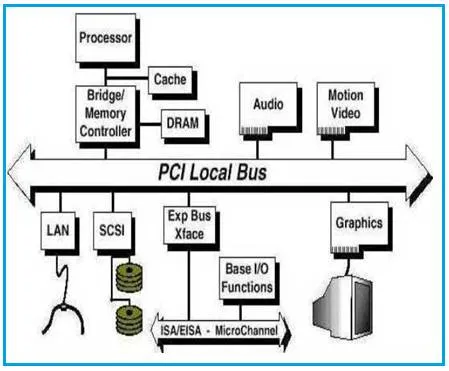
As shown in the figure, multiple devices can communicate simultaneously in parallel. Initially, PCI was developed with a 33 MHz speed, later evolving to 66 MHz and 133 MHz versions. The Windows 95 feature known as “Plug and Play” heavily utilizes the PCI bus concept. The following advantages have made PCI one of the fastest I/O buses.
Benefits or Advantages of PCI Bus
- 64-bit Addressing: Employs a 64-bit addressing scheme, enabling it to access larger amounts of memory.
- Synchronous Bus Architecture: Operates using a synchronous bus architecture, ensuring reliable data transfer.
- Linear Burst Mode Data Transfer: Supports linear burst mode data transfer, increasing data throughput.
- High Bandwidth and Speed: Offers large bandwidth and higher speeds compared to older bus technologies.
- Full Bus Mastering: Supports full bus mastering, allowing devices to initiate and control data transfers.
- Plug and Play: Supports plug and play functionality, simplifying device installation and configuration.
- Shared Bus Topology: Utilizes a shared bus topology, facilitating communication among various devices on a single bus. Once a device becomes the bus master, it can use the PCI bus to communicate directly with the CPU or memory.
Drawbacks or Disadvantages of PCI Bus
- Limited Device Support: Supports a maximum of five devices on a single PCI bus, necessitating a PCI-to-PCI bridge to support more.
- Bandwidth Limitations: As a parallel bus, it inherently has bandwidth limitations. Moreover, the available bandwidth is shared by all devices connected to the single PCI bus.
- Scalability Challenges: PCI bus cannot be easily scaled up in frequency or scaled down in voltage.
- Inadequate Clock Frequency: The PCI clock frequency can be considered inadequate by today’s standards.
- Lack of Isochronous Data Transfer: It does not support isochronous data transfer, which is critical for real-time applications.
- Limited Power Management: It does not support advanced power management features.
- No Hot-Plugging Support: PCI does not natively support hot-plugging or hot-swapping of peripherals.
Summary
PCI (Peripheral Component Interconnect) is a computer bus standard that connects expansion cards to the motherboard for communication with the processor. It enables easy hardware upgrades and reliable peripheral connectivity.