
What is Z-Wave: Advantages and Disadvantages
Advertisement
Z-Wave is a low-power wireless communication protocol designed specifically for smart home automation and Internet of Things (IoT) devices. Its advantages include low energy consumption, reliable mesh networking, and excellent interoperability, while its disadvantages include lower data rates, limited operating range, and dependence on compatible Z-Wave certified devices.
Z-Wave Network Architecture & its features
- Z-Wave is a low-power, low-data-rate wireless system developed by Sigma Designs, Inc.
- It operates in the ISM bands of 868 and 908 MHz.
- It supports data rates of 9.6 Kbps, 40 Kbps, and 100 Kbps.
- Modulation types used are FSK and GFSK.
- It has an indoor range of approximately 30 meters and an outdoor range of up to 100 meters.
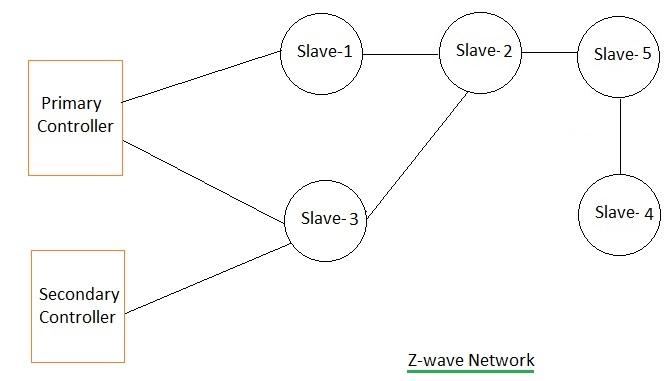
A Z-Wave network consists of controllers (one primary, multiple secondary) and slave devices. This wireless technology is used in various applications such as home automation, wireless security sensors, and emergency alarms. Due to its low power consumption, it is widely used in IoT (Internet of Things) based devices.
Advantages of Z-Wave
- Simple Installation: Z-Wave network installation is straightforward and easy. Adding or removing Z-Wave devices from an installed system is also a simple process.
- Low Power Consumption: Z-Wave devices consume very little power, resulting in significant cost savings due to reduced battery usage.
- Remote Control: Home appliances can be controlled remotely, adding a great deal of convenience for users.
- Interoperability: Z-Wave devices are interoperable with other wireless devices in the IoT ecosystem.
- Affordability: Z-Wave technology-based devices are typically cheaper, making the technology affordable while still offering great features and facilities once installed.
- Security: It employs AES-128 encryption, providing a secure wireless network for users.
Disadvantages of Z-Wave
- Limited Coverage: The coverage range is limited, requiring more Z-Wave devices to cover larger areas. This can increase the overall cost if more Z-Wave repeaters or routers are needed.
- Security Knowledge Required: Maintaining security from unauthorized access requires technical knowledge. Z-Wave operates on RF (Radio Frequency) and is wireless, making it potentially accessible from anywhere.
- Limited Topology: It only supports a tree topology structure.
- Node Limit: It supports a limited number of nodes (232), which is less than the 65,000 nodes supported by the Zigbee standard.
- Lower Data Speed: It supports a lower data communication speed of up to 100 kbps compared to Zigbee. Due to this speed limitation, Z-Wave is best suited for small data-size-based communication needs, such as monitoring and control.
Summary
Z-Wave provides a reliable, secure, and energy efficient wireless networking solution for smart home automation by enabling seamless communication among connected devices through scalable mesh networking.
Advertisement
