
What is Solar LiFi: Data Transmission Using Solar Cells
Advertisement
Solar Li-Fi is an optical wireless communication technology that combines solar panels and Li-Fi systems to transmit and receive data using visible light. By leveraging photovoltaic cells as communication receivers, Solar Li-Fi enables energy efficient wireless connectivity while supporting renewable energy and smart communication applications.
As we know, LiFi technology transmits data using light. Data is conveyed by variations in the brightness of the light signal. Traditional LiFi uses an LED lamp as the transmitter and a photodiode-based device as the receiver. For LiFi internet connectivity, the LED lamp is driven by an LED lamp driver connected to internet servers.
The Li-Fi R&D Centre of the University of Edinburgh has recently developed wireless data communication using solar energy. This concept leverages the power of existing LiFi technology and the widespread availability of solar cells for various applications.
Solar LiFi utilizes a solar cell in place of the photodiode conventionally used in LiFi. This technology will capitalize on the large presence of solar cells in IoT products such as cars and streetlights.
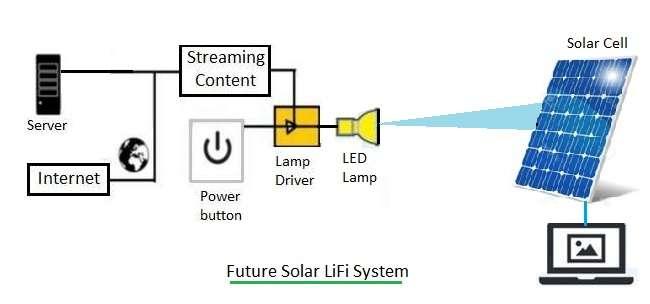
- Figure: Typical setup for solar wifi based internet technology.
- As shown, the solar cell decodes data encoded in the LED lamp’s transmitted light. The data is encoded by sudden changes in the brightness of the light signal.
- The solar panel is connected to a laptop, which receives and displays the decoded data.
- Here, the solar cell performs two functions: energy harvesting and decoding the light signal into useful information. The solar cell functions effectively as long as it can distinguish changes in brightness.
Professor Harald Haas from the Li-Fi R&D Centre of the University of Edinburgh has recently demonstrated live video transmission using the Solar LiFi concept.
Advertisement


