
What is Quasi-Optic Transmission System in 6G : Advantages and disadvantages
Advertisement
A quasi-optic transmission system is an advanced wireless communication technology that enables free-space transmission of millimeter-wave and terahertz signals using optical principles. Its advantages include ultra-high data rates and low transmission loss, while its disadvantages include alignment challenges, atmospheric attenuation, and higher implementation complexity.
Architecture of Quasi-Optic Transmission System
Quasi-optic transmission technology is being proposed for use in 6G wireless systems. Think of it as a blend of optical and RF (Radio Frequency) communication. It aims to leverage the strengths of both free space optical communication and traditional RF communication technologies.
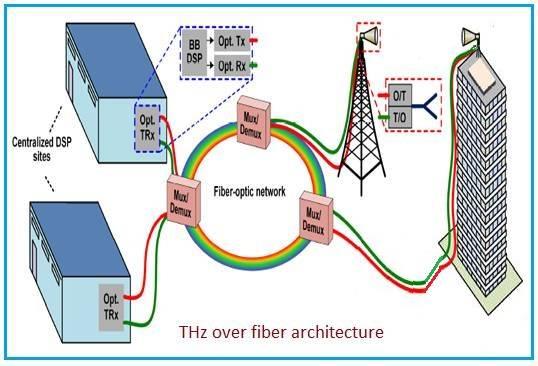
The system essentially uses a beam of light to transmit data between antennas that are relatively close together – we’re talking just a few meters. This allows for high-speed data transfer without the need for physical cables.
However, light beams are susceptible to interference from atmospheric conditions and physical obstructions. This is where quasi-optic transmission comes in; it’s designed to mitigate these drawbacks. The process involves optical-to-THz (Terahertz) conversion at the transmitting end and THz-to-optical conversion at the receiving end.
Horn antennas are employed to transmit and receive THz frequencies. A DSP (Digital Signal Processor) handles the baseband processing. Fiber optic networks provide the interface to the 6G backbone.
Benefits or Advantages of Quasi-Optic Transmission Systems
- High-Speed Data Transfer: Optical communication allows for faster data transfer over short distances compared to traditional RF communication.
- Low Latency: Optical communication minimizes delays between transmission and reception.
- Immunity to EM Interference: Optical communication isn’t affected by electromagnetic interference, which improves security and reliability.
- Long-Distance Communication: RF communication provides the ability to communicate over longer distances.
Drawbacks or Disadvantages of Quasi-Optic Transmission Systems
- Requires Line-of-Sight (LOS): A clear, unobstructed path between the transmitting and receiving antennas is crucial, which can be difficult to achieve in some environments.
- Precise Alignment: Accurate alignment between the transmitter and receiver antennas is necessary for optimal performance.
- Higher Implementation Costs: These systems tend to be more expensive to implement compared to other solutions.
Summary
Quasi-optic transmission systems are expected to play a crucial role in future 6G communications by supporting ultra-high-frequency wireless links with improved efficiency, despite ongoing engineering and deployment challenges.
Advertisement


