
What is I3C Interface : Advantages and Disadvantages
Advertisement
I3C (Improved Inter-Integrated Circuit) is a modern serial communication interface developed to overcome the limitations of I2C. It offers higher data rates, lower power consumption, and advanced device management capabilities. Advantages include improved performance and backward compatibility, while disadvantages include increased implementation complexity and limited adoption.
Introduction : The I3C (Improved Inter-Integrated Circuit) specification, version 1.0, was initially released in October 2018 by the MIPI Alliance, Inc. The specifications were updated in July 2021. I3C is a two wire interface, similar to I2C. It offers a fast, low-cost, and low power digital interface with more benefits compared to I2C, SPI, and UART. It is backward compatible with I2C and improves upon it. I3C uses less energy for data/control signal transport and uses fewer physical pins. The specification defines a multi-drop interface between host processors and peripheral devices, such as sensors.
Key Features of I3C interface
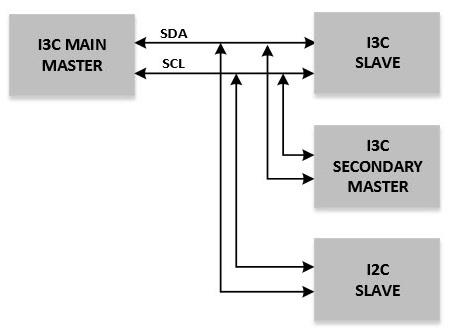
Here are some key features of the I3C interface:
- Data Rate: Up to 33.3 Mbps (Max.) at 12.5 MHz using push-pull configuration
- I2C Compatibility: Coexists with legacy I2C devices on the same bus; supports legacy I2C messaging and static addressing
- Dynamic Addressing: Allows devices to be assigned addresses dynamically
- In-Band Interrupt: Uses the same communication bus for interrupts
- Multi-Master/Multi-Drop: Supports multiple masters and multiple devices on the same bus
- Hot Join Support: Allows devices to join the bus after it has already been configured
- In-Band Command Codes: Supports integrated commands within the communication stream
Benefits or Advantages of the I3C Interface Bus
- Backward Compatibility: I3C is backward compatible with I2C, allowing for seamless integration of I2C devices.
- Upgrade Potential: Offers a performance and power consumption upgrade to existing I2C and SPI interfaces.
- Dynamic Addressing: Eliminates the need for hardware-based address configuration, as devices get their specific address using dynamic address assignment. It also supports static addressing for I2C devices, behaving like the I2C standard.
- Simplified Interrupt Handling: The in-band interrupt feature eliminates the need for an extra interrupt pin.
- Reduced Pin Count: Requires only two signal lines, compared to the four lines needed by SPI.
- Collision Avoidance: The multi-drop capability and dynamic addressing technique help avoid collisions on the bus.
- Clear Master Handover: The standard clearly defines the master ownership and handover procedure.
- Integrated Commands: Supports in-band integrated commands, simplifying communication.
- Higher Data Rate: Offers a higher effective data rate (~33.3 Mbps at 12.5 MHz) compared to I2C (~3 Mbps at 3.4 MHz).
- Hot Joining: I3C slaves can join the bus even after it has been configured.
Drawbacks or Disadvantages of the I3C Protocol
- Lower Data Rate than SPI: Offers a lower effective data rate compared to SPI (~ approx. 60 Mbps at 60 MHz).
- Limited Addressing: Supports only 7 bits for device addressing.
- New Standard: As a relatively new standard, widespread adoption across new devices will take time.
Summary
I3C is an advanced sensor and peripheral communication interface designed for modern electronics. Advantages include faster data transfer and lower power usage, while disadvantages include ecosystem maturity and design complexity.
Advertisement


