
What is I2S Bus : Advantages and Disadvantages
Advertisement
I2S (Inter-IC Sound) is a digital serial interface designed specifically for transmitting audio data between devices such as codecs, DSPs, microphones, and microcontrollers. It provides synchronized audio communication with minimal complexity. Advantages include high-quality audio transfer and simple architecture, while disadvantages include limited application scope and additional clock requirements.
Introduction : The I2S (Inter-IC Sound) interface was initially developed for use in CD player designs. Today, it’s widely used in various applications where digital audio data needs to be transferred between integrated circuits (ICs). I2S interface is used in most audio Analog to Digital Converters (ADCs), Digital to Analog Converters (DACs), Digital Signal Processors (DSPs), sample rate converters, and microcontrollers.
Key features of I2S interface
I2S stands for Inter-IC Sound, and it’s a standard used to connect digital audio devices. The I2S bus is a three-line serial bus consisting of:
- Serial Data (SD)
- Word Select Line (WS)
- Clock Line (SCK)
Serial data is transmitted using 2’s complement format, with the Most Significant Bit (MSB) sent first.
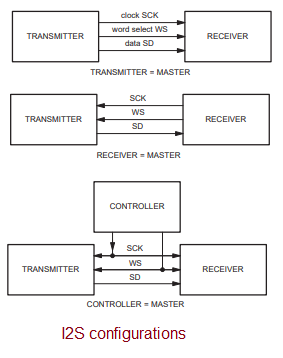
Figure 1: Various configurations of the I2S bus used for digital audio data flow between various ICs.
An IC with an I2S port can be configured in either master mode or slave mode.
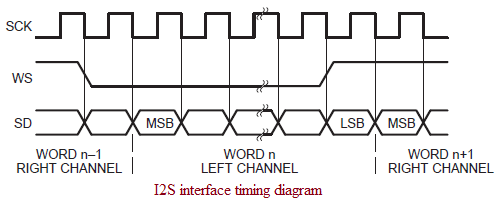
Figure 2: I2S bus interface timing diagram.
The Word Select line indicates the channel being transmitted. WS can change on either the trailing or leading edge of the serial clock:
- WS = 0: Channel 1 (Left)
- WS = 1: Channel 2 (Right)
Benefits or Advantages of the I2S Bus
- Simple Receiver Designs: It uses separate clock and serial data lines, resulting in simpler receiver designs compared to asynchronous systems.
- No Data Synchronization Issues: With a single master device, there are no issues with data synchronization.
- Simplified Microphone Integration: I2S output-based microphones don’t require an analog front end. This is beneficial in wireless microphones with digital transmitters, allowing for a completely digital connection between the transducer and the transmitter.
- Low Jitter: The separate data and clock lines contribute to very low jitter.
- Fully Digital Audio Signal Chain: It delivers a fully digital audio signal chain, eliminating the need for ADCs/DACs and pre-amplifiers that are commonly found in traditional audio setups.
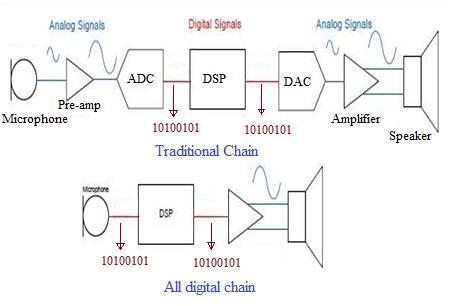
Figure 3: Traditional audio chain vs. all-digital audio chain.
Drawbacks or Disadvantages of the I2S Bus
- Not Suitable for Cables: It’s not designed for data transfer over cables.
- Synchronization Problems: Synchronization issues between SCK, WS, and data signal lines can arise, especially at high sampling frequencies and bit rates. This is due to differences in propagation delays between the clock and data lines.
- No Error Detection: The lack of an error detection mechanism can lead to errors in data decoding.
- Lack of Standardization: There is no standard interconnecting cable and connectors defined for the I2S bus, leading to different manufacturers using different connectors.
- Limited to Inter-IC Communication: Primarily used for inter-IC communication on the same PCB.
- Bit Clock Rate Compatibility: Some ICs support a maximum of 32 or 48-bit clocks per stereo audio frame. System designers need to ensure compatibility when interfacing two ICs with different bit clock rates.
Summary
I2S is a dedicated digital audio communication interface for high-fidelity sound transmission. Advantages include low-noise audio transfer, while disadvantages include limited flexibility outside audio applications.
Advertisement


