
What is OMR : Optical Mark Recognition Advantages and Disadvantages
Advertisement
Optical Mark Recognition (OMR) is an automated data capture technology that detects marked responses on specially designed forms using optical scanners. It is widely used for examinations, surveys, and voting systems because it processes large volumes of forms quickly and accurately, although it requires standardized document formats.
Optical Mark Recognition (OMR) technology plays a pivotal role in data collection, particularly in education and survey environments. It’s well-known for its efficiency in reading marked data, which helps reduce manual entry errors and accelerates the overall data processing. However, OMR does come with limitations that can affect its effectiveness in certain situations.
OMR technology finds applications in various sectors, including education and banking. In education, it’s used for grading assessments and analyzing responses. In banking, it’s valuable for analyzing feedback forms and processing voting ballots where respondents mark their choices.
How OMR Works
Let’s break down how OMR scanners and the underlying technology work:
- Form Design: Forms are designed with designated areas for respondents to mark their answers. Typically, these are bubbles or checkboxes.
- Marking: Respondents fill in these marks using pencils or pens. The marks need to be dark and clear to ensure the scanner can read them accurately.
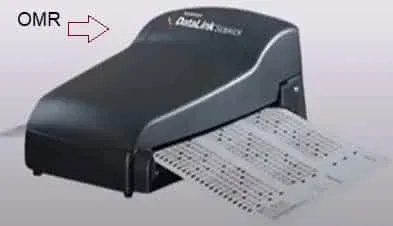
- Scanning: The completed forms are scanned using an OMR scanner. The scanner uses light to detect the presence (or absence) of marks in the predetermined positions.
- Data Conversion: The scanner interprets the marks it detects and converts them into digital data.
- Data Processing: The data is then processed and analyzed using OMR software, often for assessment purposes.
Applications of OMR in Banking
Here are some common applications of OMR technology within the banking sector:
- Surveys and Feedback Forms: Banks can efficiently gather customer feedback and satisfaction data using OMR.
- Exams and Assessments: OMR can be used for employee assessments, certification exams, and training evaluations within the banking environment.
- Ballot Processing: For internal voting processes, such as board member elections, OMR provides an accurate and efficient way to tally votes.
Advantages of OMR Technology
Here are the key benefits of using OMR technology with Optical Mark Reader devices:
- High-Speed Processing: OMR can process large volumes of documents rapidly, making it ideal for large-scale surveys and exams.
- Accuracy: High accuracy in capturing marks minimizes the likelihood of errors during data collection.
- Cost Reduction: OMR reduces the need for manual data entry, which lowers labor costs and minimizes the potential for human error.
- Ease of Use: OMR forms are simple for respondents to use, requiring only basic instructions for marking.
- Scalability: OMR is suitable for organizations with a large number of respondents due to its ability to handle large-scale data collection.
Disadvantages of OMR Readers
Keep in mind these limitations of OMR reader technology:
- Form Design Constraints: Forms must be designed with precise marking areas, which can limit flexibility in the form layout.
- Marking Accuracy Dependence: Incomplete or poorly filled marks can lead to errors in data capture. Respondents need to be careful to mark their answers correctly.
- Initial Investment: OMR requires specialized scanners and software, which may involve additional costs for setup and ongoing maintenance.
- Limited Data Types: OMR can only capture data in the form of marks. It’s not suitable for capturing handwritten or printed text.
- Simple Responses Only: OMR readers are best suited for capturing simple, marked responses, such as multiple-choice answers, making them unsuitable for complex data collection needs.
Summary
OMR (Optical Mark Recognition) is a technology that reads marked responses from printed forms using optical scanning. It enables fast, accurate, and efficient data collection for exams and surveys. However, specialized forms, careful marking, and limited flexibility are its main disadvantages.