
What is QAM Modulation: Advantages and Disadvantages
Advertisement
Quadrature Amplitude Modulation (QAM) is a digital modulation technique that transmits data by varying both the amplitude and phase of a carrier signal. Its advantages include high spectral efficiency and faster data transmission, while its disadvantages mainly involve greater sensitivity to noise and signal distortion in communication systems.
QAM Modulation Process and Constellation Diagram
QAM stands for Quadrature Amplitude Modulation. This modulation technique cleverly uses both amplitude and phase variations of a carrier signal to represent binary data.
For example, in 16QAM, a single complex symbol represents 4 bits of data. Similarly, 64QAM represents 6 bits with one complex symbol, and so on.
As the “modulation order” (e.g., 16, 64, 256, 512, 1024, 4096) increases in QAM, the number of bits mapped per carrier also increases. However, this comes at a cost: the phase transition between symbols becomes smaller. This makes the receiver more complex, as it needs to be more precise to accurately recover the original information bits.
QAM can represent more bits per carrier than simpler modulation schemes. There are various variants as follows.
- 16QAM maps 4 bits per carrier.
- 64QAM maps 6 bits per carrier.
- 256QAM maps 8 bits per carrier.
- And so on, for higher-order QAM schemes.
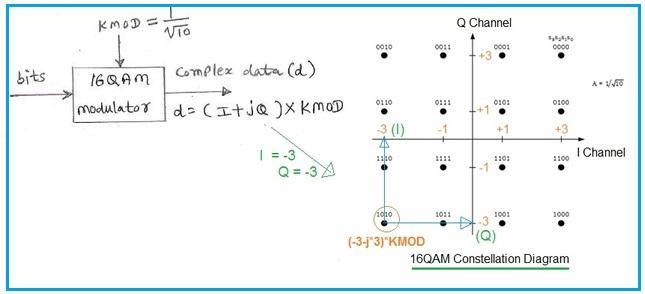
The 16-QAM modulation process can be described in the following steps:
Step-1 : Input Bit Stream: The incoming binary data stream is divided into groups of 4 bits, since 16-QAM represents 4 bits per symbol (2^4 = 16).
Step-2 : Symbol Mapping: Each 4-bit group is mapped to one of 16 constellation points using a predefined mapping scheme (typically Gray coding) to minimize bit errors.
Step-3 : I-Q Component Generation: The mapped symbol is separated into In-phase (I) and Quadrature (Q) amplitude levels, where each component carries 2 bits.
Step-4 : Carrier Modulation: The I component modulates a cosine carrier, while the Q component modulates a 90 degree phase shifted sine carrier.
Step-5 : Signal Combination: The modulated I and Q signals are summed to generate the final 16-QAM passband signal, which is transmitted over the communication channel.
Step-6 : Transmission: The resulting waveform conveys 4 bits per symbol, providing higher spectral efficiency than lower order modulation schemes such as QPSK while requiring a higher signal to noise ratio (SNR) for reliable detection.
Benefits or Advantages of QAM Modulation
- High Spectral Efficiency: QAM transmits multiple bits per symbol, enabling higher data rates within the same bandwidth compared to simpler modulation schemes.
- Efficient Bandwidth Utilization: By varying both the amplitude and phase of the carrier, QAM makes better use of the available spectrum, making it suitable for bandwidth-limited communication systems.
- Flexible Data Rate: Different QAM orders (e.g., 16-QAM, 64-QAM, 256-QAM) can be selected to balance data throughput and robustness according to channel conditions, enabling adaptive modulation in modern wireless systems.
Drawbacks or Disadvantages of QAM Modulation
- Susceptibility to Noise: As the number of states (possible symbols) increases in QAM, the states become more closely spaced on the constellation diagram. This makes the signal more vulnerable to noise. Because of this, QAM receivers are generally more complex than receivers for other modulation types.
- Linearity Requirements: QAM uses the amplitude component of the signal to represent data. Therefore, it requires a high degree of linearity. This means that linear amplifiers, which consume more power, are necessary.
Summary
As the QAM modulation order increases (16-QAM, 64-QAM to 4096-QAM), spectral efficiency and achievable data rates improve significantly by transmitting more bits per symbol. However, higher order QAM requires progressively higher SNR, is more susceptible to noise, interference, and nonlinear distortions, and demands greater transmitter/receiver complexity, making it less robust in challenging channel conditions.
Tags
Advertisement


