
Jakes' Model: Formula and Basics
Advertisement
Jakes’ Channel Model is a widely used statistical model for simulating Rayleigh fading in wireless communication channels, particularly useful for understanding the behavior of signals in mobile radio environments. This page dives into the fundamentals of Jakes’ Model and presents the Jakes’ model formula. You’ll also find links to channel models implemented in MATLAB.
One of the most well known fading channel models was introduced by Jakes. He proposed a model for Rayleigh fading that’s based on summing sinusoids. Jakes’ model helps simulate the multipath fading effects that occur when a transmitted signal takes multiple paths to reach the receiver, each path having a different delay, phase shift, and Doppler shift due to relative motion.
Doppler Effect in Jakes’ Model
The maximum doppler frequency is expressed as follows.
Where,
- v = Mobile Speed
- λ = Wavelength
- Fc = Carrier Frequecy
- c = Speed of light
The fd determines how fast the channel changes over time.
Jakes’ Model Formula or Equation
The following section details Jakes’ model, complete with its formula and equations.
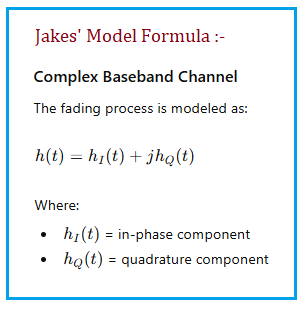
The complex baseband channel : The fading process is modeled as following equation-1.
The in-phase (I) and Quadrature (Q) components are modeled as following equation-2.
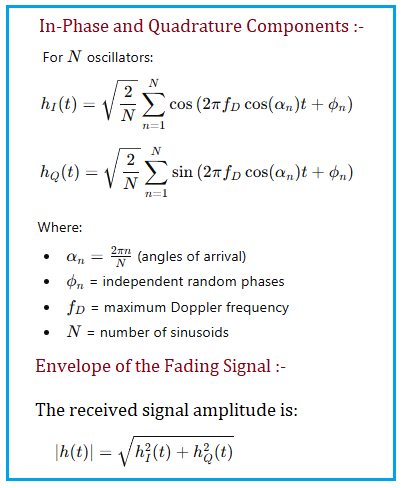
- αn = 2πn/N (i.e. angle of arrival)
- 𝜙n = independent random phases
- 𝑓D = maximum Doppler frequency
- 𝑁 = number of sinusoids
Envelope of fading signal : The received signal amplitude is modeled by equation-2. This envelope follows a Rayleigh distribution, which matches real-world measurements in rich scattering environments.
The Jakes’ model reproduces the classical doppler spectrum as per equation-3.
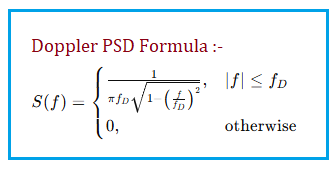
The spectrum has U-shape and it has peaks at +/- fD.
Physics Idea behind
When mobile user moves
- The received signal is a sum of many reflected waves
- Each wave arrives with a different Doppler shift
- The superposition causes rapid fluctuations in amplitude and phase
Jakes’ model approximates this process using a finite number of sinusoids with carefully chosen frequencies and phases.
Applications (Where it is used)
- It is used to simulate small scale fading caused by multipath propagation
- Simulatation of time varying wireless channels due to user motion.
- Simulating Rayleigh fading channels for mobile communications
- Performance analysis of modulation and coding schemes
- Testing diversity techniques (e.g., MIMO, antenna diversity)
- Evaluating mobile cellular system performance in urban environments
Strengths of Jakes’ model
- Simple and computationally efficient
- Produces realistic rayleigh fading
- Correct doppler spectrum
Limitations of Jakes’ model
- Assumes isotropic scattering (scatterers are uniformly distributed)
- Assumes no Line of Sight component (Rayleigh fading only)
- Not suitable for modeling frequency selective or Rician fading unless modified
Channel model MATLAB Codes
Summary
Jakes’ model provides a practical and widely accepted method for simulating Rayleigh fading channels in wireless communications. By breaking down a complex, time-varying multipath environment into a deterministic sum of Doppler-shifted sinusoids, this model enables deep insights into how mobile movement and scattering impact signal amplitude and phase over time. Its ability to approximate the classic Doppler spectrum makes it indispensable for simulating and analyzing modern wireless systems from cellular networks to emerging 5G/6G applications.
Advertisement


