
What is FDMA, TDMA & CDMA : Key differences
Advertisement
FDMA (Frequency Division Multiple Access), TDMA (Time Division Multiple Access), and CDMA (Code Division Multiple Access) are essential multiple access techniques in telecom networks. They enable multiple users to share a common communication medium, such as a wired or wireless link. FDMA divides the available frequency spectrum into non-overlapping frequency channels. TDMA divides time into multiple time slots. CDMA assigns unique spreading codes to spread data across the entire band. Mobile computing devices, like smartphones and laptops, utilize these techniques in varying ways depending on the underlying cellular network technology they support. Let us understand these techniques with examples and explore differences between them.
What is FDMA?
In Frequency Division Multiple Access, the entire frequency spectrum is divided into multiple RF channels or carriers. Each user is allocated a dedicated frequency channel for the entire duration of their communication session. This approach efficiently allows multiple users to share a limited frequency spectrum.
FDMA is commonly used in analog communication systems and early digital systems.
Examples:
- In GSM, a 25 MHz frequency band is divided into 124 RF carriers with 200 KHz bandwidth each.
- In Satellite communication, a 500 MHz transponder bandwidth is divided into 24 channels, each having 40MHz (36 MHz useful BW and 4MHz guard BW).
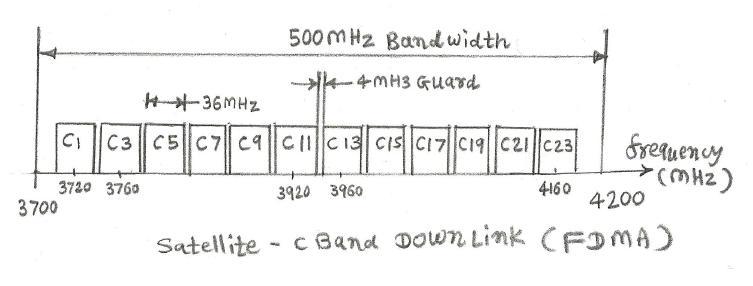
FDMA provides predictable performance and reduced interference between users, making it suitable for traditional radio broadcasting and cellular networks. There are two main variants of FDMA:
- FAMA (Fixed Assignment Multiple Access)
- DAMA (Demand Assignment Multiple Access)
Advantages of FDMA
- Simple implementation and low complexity
- Continuous transmission with minimal delay
- No strict time synchronization required
- Suitable for analog and voice communications
Disadvantages of FDMA
- Low spectral efficiency due to guard bands
- Fixed channel allocation can waste bandwidth
- Limited capacity compared to TDMA and CDMA
- Susceptible to frequency planning issues.
What is TDMA?
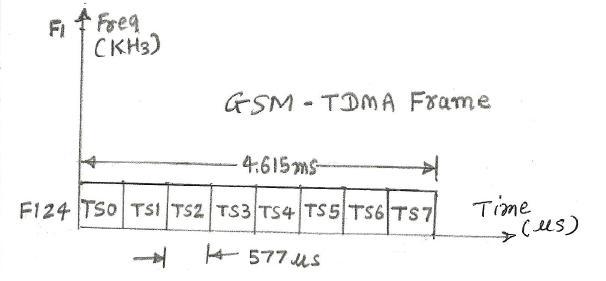
In Time Division Multiple Access, the entire bandwidth is shared among different subscribers at fixed pre-determined or dynamically assigned time intervals or slots. Each user is assigned exclusive access to a time slot for communication, taking turns to transmit or receive data during their allocated time slots.
TDMA efficiently shares the same frequency band among multiple users, allowing them to use the same channel at different time instances. This helps to maximize spectrum utilization and accommodate more users within a limited frequency band.
Example:
In GSM, mobile devices are assigned specific time slots within a frequency band to transmit and receive data. Each time slot is typically 577 microseconds in duration, and multiple users share the same frequency band by using different time slots.
Advantages of TDMA
- Better spectrum utilization than FDMA
- Supports multiple users on the same frequency channel
- Flexible allocation of time slots. Reduced interference between users
Disadvantages of TDMA
- Requires precise time synchronization
- Transmission delays may occur due to slot scheduling
- Capacity is limited by the number of available time slotss
- More complex than FDMA
What is CDMA?
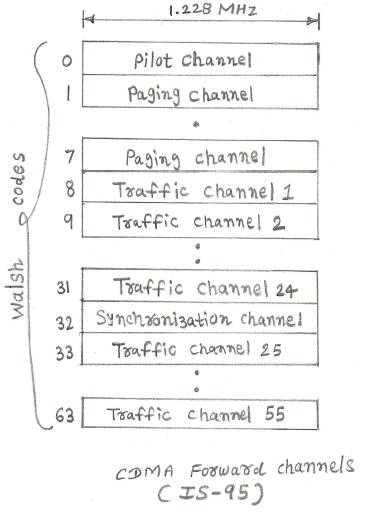
In CDMA, multiple users share the same frequency band simultaneously using unique spreading codes. The system operates based on the spread spectrum concept, where each user employs a unique spreading code to spread their data across the entire frequency band.
This allows for better capacity and interference management in wireless systems.
Example:
In IS-95 (CDMAOne), the system uses around 64 spreading codes for both forward and reverse channels. WCDMA employs a significantly larger number of spreading codes compared to earlier CDMA versions, typically in the range of thousands of codes for both forward and reverse channels.
Advantages of CDMA
- High spectral efficiency and system capacity
- Improved resistance to interference and multipath fading
- Soft handoff support enhances mobility
- Better security and privacy due to spreading codes
Disadvantages of CDMA
- Complex implementation and signal processing
- Requires strict power control to avoid the near-far problem
- Higher computational requirements
- System performance degrades as the number of users increases
Difference Between FDMA, TDMA and CDMA
Let’s compare FDMA, TDMA, and CDMA to highlight the differences between these techniques used for wireless mobile communication.
| Parameters | FDMA | TDMA | CDMA |
|---|---|---|---|
| Basic principle | Divides frequency spectrum into non-overlapping frequency channels | Divides time into multiple time slots | Allows multiple users to share the same frequency band simultaneously using unique codes |
| Resource allocation | Frequency based | Time based | Spreading code based |
| Synchronization Required | No | Yes | Minimal |
| Simultaneous operation | Possible, users can communicate simultaneously using different channels | Not possible, users take turns to communicate within their slots | Possible, users can communicate simultaneously in the same band using their unique codes |
| Power control | Essential to maintain balance between users’ transmit power | Important to ensure proper reception within assigned time slots | Crucial to manage the transmit power of users to maintain signal quality and minimize interference |
| Spectral Efficiency | Low | Medium | High |
| Interference Resistance | Low | Medium | High |
| Complexity | Low | Medium | High |
| Capacity | Low | Medium | High |
| Examples | AMPS (Advanced Mobile Phone System), Analog radio broadcasting | GSM (2G) cellular networks | CDMAOne, CDMA2000 etc. |
Conclusion
Multiple access techniques such as FDMA, TDMA, and CDMA have their respective advantages and are best suited for specific communication system requirements. While FDMA and TDMA were more prevalent in earlier generations of wireless communication, CDMA gained significant adoption in 3G and beyond.
In modern communication systems, multiple access techniques like OFDMA and its variants have become more common due to their improved spectral efficiency and robustness in high data rate scenarios, as seen in 4G LTE and 5G NR (New Radio) networks. Hybrid access methods may combine these three techniques to achieve higher capacity, improved spectral efficiency, and better management of interference in complex multi-user scenarios.
Advertisement


