
What is HAPS : High Altitude Platform System Advantages and Disadvantages
Advertisement
A High Altitude Platform System (HAPS) is an aerial communication platform positioned in the stratosphere to provide broadband connectivity, surveillance, and remote sensing services. It serves as a bridge between satellites and terrestrial networks. Advantages include wide area coverage and lower latency, while disadvantages include environmental challenges and operational complexity.
HAPS (High Altitude Platform System) Architecture
High Altitude Platform Systems are typically positioned at altitudes ranging from 17 to 50 kilometers. This region of the atmosphere above the Earth’s surface is known as the stratosphere. These platforms consist of airplanes or airships (balloons), which can be either manned or unmanned.
Ground control stations manage these systems. They are utilized for various applications including:
- Narrowband and broadband telecommunication services
- Remote sensing
- Multimedia applications, such as TV, video on demand, telephony, and high-speed internet
HAPS systems find particular use in rural areas and underserved regions.
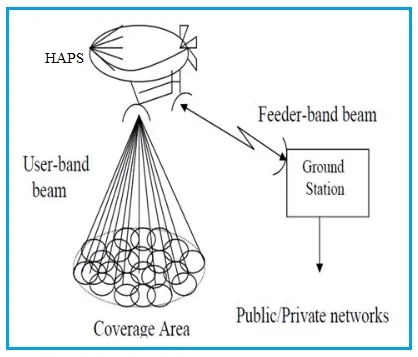
The figure depicts the architecture of a HAPS system.
HAPS can be developed using both airships and high altitude aircraft. Communication relies on uplink and downlink connections. The uplink transmits data from the ground station to the HAPS, while the downlink transmits data from the HAPS back to the ground station.
Different frequency bands are employed within HAPS systems, including 2 GHz, 6 GHz, 47/48 GHz, and 27/31 GHz. Uplink and downlink connections utilize distinct frequency bands to prevent interference.
Advantages of HAPS Systems
- No Launch Vehicle Required: HAPS do not need a rocket launch. They can move globally under their own power or remain stationary.
- Easier Maintenance: These systems can be brought back to Earth, simplifying maintenance and payload configuration, making them less expensive.
- Higher Capacity: Due to their lower altitude, HAPS provide higher capacity through efficient high-frequency reuse.
- Low Latency: HAPS offer lower latency compared to satellites, leading to quicker response times.
- Wide Coverage & Less Interference: They offer broad coverage areas and reduced interference.
- Environmentally Friendly: HAPS can be powered by solar technology and non-polluting fuel cells, making them a greener option.
Disadvantages of HAPS Systems
- Wind Challenges: The primary challenge is the presence of strong winds in the stratosphere. The average minimum wind velocity in this layer is 30 to 40 m/s at altitudes between 65,000 and 75,000 feet, depending on latitude. HAPS systems are designed to withstand these winds, but sudden gusts can lead to temporary or even complete loss of communication.
Summary
HAPS platforms deliver wireless communication and monitoring services from high altitudes. Advantages include extensive coverage and reduced latency, while disadvantages include deployment challenges and weather-related constraints.