
What is GPIB : Advantages and Disadvantages
Advertisement
General Purpose Interface Bus (GPIB), also known as IEEE 488, is a communication interface widely used for connecting test and measurement instruments. It enables centralized control of multiple devices through a single controller. Advantages include reliability and broad instrument support, while disadvantages include limited speed and cable length restrictions.
Key Features of GPIB Interface
The GPIB IEEE-488 interface bus consists of 8-bit parallel lines. The GPIB connector has a total of 24 pins. It utilizes 16 signal lines, comprising 8 data lines (bi-directional), 3 handshake lines, and 5 for bus management. Additionally, there are 8 ground (GND) lines.
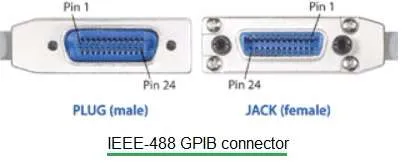
Figure 1: GPIB IEEE-488 connectors in plug and jack configurations.
The GPIB bus employs a 5-bit address, providing a total of 31 possible addresses for use by equipment on the GPIB interface. The IEEE standard permits approximately 15 devices to share a GPIB bus over a length of 20 meters.
Advantages of GPIB
The following are benefits of using GPIB:
- GPIB interface is simple.
- GPIB interface port is widely available on all test and measurement equipment.
- The GPIB cable uses very rugged and robust connectors.
- Using the GPIB interface, a single controller can monitor and control multiple test and measurement equipment or instruments. This is illustrated in Figure 2, showing two different configurations: linear and star.
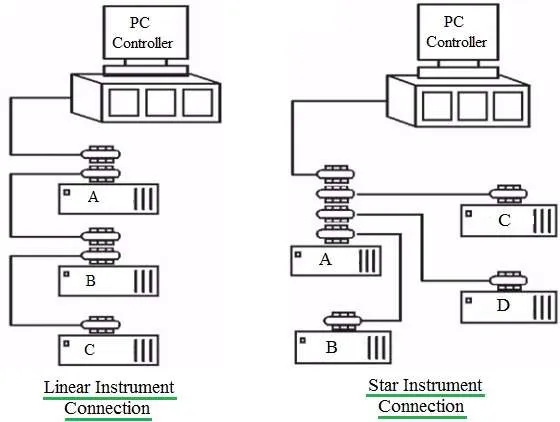
Figure 2: GPIB in linear and star connections.
Disadvantages of GPIB
The following are drawbacks of using GPIB:
- The GPIB connectors are bulky.
- The interface provides low bandwidth data transfer.
- The GPIB interface is used for low-speed data communication, unlike modern interfaces designed for high-speed communication.
- Modern instruments have gradually discontinued its use. It is likely to become obsolete in a few years.
Summary
GPIB simplifies communication between computers and test instruments. Advantages include mature ecosystem and device compatibility, while disadvantages include slower performance and scalability limitations.