
What is Optical Modulation Index (OMI)
Advertisement
The optical modulation index measures the degree of modulation applied to an optical carrier signal relative to its average optical power. It is an important parameter in fiber optic communication systems, influencing signal quality, transmission efficiency, receiver performance and overall optical network reliability. This page describes the optical modulation index formula. AM and FM modulations are used in optical fiber. The optical modulation index in both the electrical and optical domains are described.
Modulation Index in AM/FM
The modulation index for AM is expressed as follows:
where:
- is the modulating signal.
- is the carrier signal.
The modulation index for FM is expressed as follows:
where:
- is the frequency deviation.
- is the modulating signal.
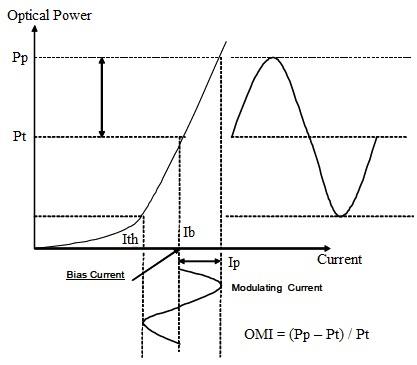
The term OMI (Optical Modulation Index) is defined as the amount by which the instantaneous power of the optical carrier varies around its average power. OMI is defined in the RFoG (RF over Glass Fiber) specification for amplitude modulation. It is expressed in units of percentage (%).
OMI is 100% when the peak of the amplitude-modulated sine wave on the optical carrier modulates the instantaneous power of the carrier from zero power to twice the average power value.
Figure 1 depicts the curve between optical power vs. modulating current. OMI is expressed by the following equation in the optical domain:
Where:
- = Peak optical power output of the laser
- = Optical power value at bias current
OMI is expressed by the following equation in the electrical domain:
Where:
- = Peak modulating current
- = Bias current
- = Threshold current of laser
-
OMI should always be measured with a CW carrier which has the same average power as the desired one.
-
OMI value always refers to the modulation index of the entire RF signal.
Tags
Advertisement


