
EPS vs EPC in LTE: Understanding the Key Differences
Advertisement
This page compares LTE EPS vs EPC and highlights the functional differences between EPS and EPC in an LTE system.
Introduction
4G (4th Generation) LTE (Long Term Evolution) was initially introduced with 3GPP release-8. It has evolved further with release-15 and beyond to include even more features than the initial release.
A 4G network consists of a radio functionality part and a core functionality part. The radio function is based on LTE 3GPP standards, and the core network is based on EPC 3GPP standards.
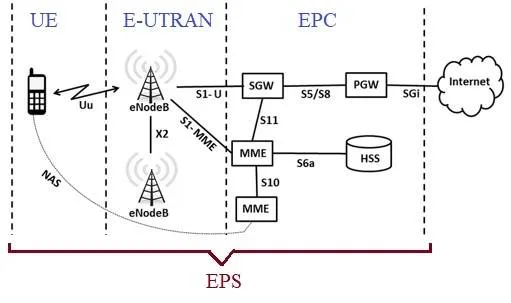
EPS vs. EPC
-
EPS stands for Evolved Packet System, while EPC stands for Evolved Packet Core.
-
EPS is a combination of E-UTRAN, EPC, and UE. UE (User Equipment) refers to any device controlled by the user, such as a mobile phone, tablet, laptop, USB dongle, etc. The figure above depicts the EPS architecture, where the UE is connected to the EPC over the E-UTRAN network. The evolved NodeB (eNodeB) is the base station of the LTE radio system.
-
EPS architecture consists of the User Equipment (UE), radio network (E-UTRAN), core network (EPC), and IP network (IMS).
-
EPC consists of the SGW (Serving Gateway), PGW (Packet Data Network Gateway), MME (Mobility Management Entity), and HSS (Home Subscriber Server). It is connected to external networks such as IMS (IP Multimedia Core Network Subsystem).
Continue Learning 4G LTE
- 4G LTE Basics Tutorial
- 4G LTE Architecture: Network Elements and Interfaces
- LTE Frame Structure
- LTE Channel Types: Logical, Transport and Physical Channels
- LTE Protocol Stack: User Plane vs. Control Plane
- 4G LTE Physical Layer & its modules
- LTE Frequency Bands: FDD, TDD and E-UTRA Bands
- LTE Carrier Aggregation & its benefits
- 4G LTE Network Security
- LTE Cell Search Procedure
- LTE UE Uplink Network Entry : Random Access Procedure
- LTE Paging Procedure Mechanism and Call Flow