
What is eCPRI in 5G NR : Advantages and Disadvantages
Advertisement
eCPRI (Enhanced Common Public Radio Interface) is a fronthaul communication protocol used in 5G networks to connect distributed radio units with centralized baseband units. It improves network efficiency and flexibility compared to traditional CPRI. Advantages include reduced bandwidth requirements and scalability, while disadvantages include synchronization complexity and deployment challenges.
Key features & architecture of eCPRI
- eCPRI stands for Enhanced Common Public Radio Interface.
- The core idea is to divide the functionalities of a Base Station (BS) into two blocks: REC (Radio Equipment Control) and RE (Radio Equipment). These blocks are connected via a packet-based fronthaul transport network, such as Ethernet or IP. This is illustrated in Figure 1. Typically, both REC and RE are connected using optical fiber links.
REC and RE terms are used with CPRI whereas the same terms are renamed as eREC and eRE in the eCPRI interface.
- A group of companies including Ericsson, Huawei, NEC, and Nokia are developing and maintaining eCPRI specifications.
- eCPRI handles the following service points: User Plane Traffic, Synchronization, and Control & Management.
- eCPRI can be used between one eREC and one eRE, or between two eRECs and two eREs.
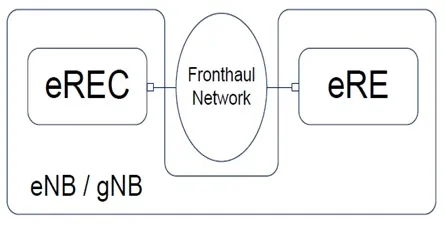
- Both eREC and eRE are physically separated, with the eRE placed near the antenna and the eREC located further away.
- eREC handles part of the PHY (Physical) layer functions and upper-layer functions.
- eRE handles the other part of the PHY layer functions, DAC (Digital to Analog conversion), and other analog radio frequency functions before connecting the signal to the antenna.
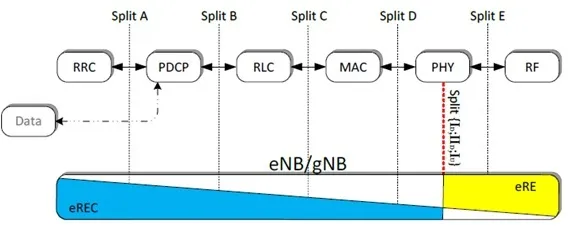
- Figure 2 depicts various functional decompositions and their mapping to eREC and eRE elements of eNB/gNB at the RAN (Radio Access Network) layer level.
- The physical layer (PHY) has been split and named {I D , II D , I U } to achieve many benefits of the eCPRI interface, as mentioned below.
- eCPRI can be interfaced with electrical cables, electrical backplanes, and optical fibers. Ethernet types used with eCPRI include 10G, 25G, 40G, and 100G.
Benefits or Advantages of eCPRI
Following are the benefits or advantages of eCPRI:
- Reduced Electronics at Antenna Side: Fewer electronics hardware components are needed at the antenna side, reducing expenditure on site maintenance because air conditioning becomes less critical. Furthermore, power consumption is reduced, leading to electricity savings.
- Simplified Troubleshooting: With the base station architecture divided into BBU (Baseband Unit) and RRH (Remote Radio Head), it’s easier to troubleshoot issues at the lower layers (i.e., at the BBU) remotely rather than at the antenna site. BBU and RRH used in the CPRI interface are known as eREC and eRE, respectively, in the eCPRI interface.
- Reduced Bandwidth Requirements: In CPRI, high bandwidth was needed to transport I/Q samples between REC and RE. eCPRI significantly reduces this bandwidth requirement. The required bandwidth can scale according to user plane traffic.
- Software Upgradability: The interface can be upgraded via software, allowing new features to be added in the future as needed.
- Simultaneous Traffic Support: Ethernet can carry eCPRI traffic as well as other traffic types simultaneously. eCPRI traffic from different vendors can also be carried simultaneously over Ethernet. The same Ethernet OAM (Operations, Administration, and Maintenance) can be used for the operation and maintenance of the eCPRI interface.
- Reduced Jitter and Latency: It uses the IEEE 802.1CM standard, which helps in reducing jitter and latency for high-priority traffic.
- Intra-PHY Split Advantages: The advantages of intra-PHY split in the eCPRI interface include features such as CA (Carrier Aggregation), Downlink CoMP, Network MIMO, Uplink L1 Comp, Joint Processing, etc. Some of these features might also be supported by other splits.
Drawbacks or Disadvantages of eCPRI
Following are the drawbacks or disadvantages of eCPRI:
- No Backward Compatibility: Though both CPRI and eCPRI can co-exist in a single system, eCPRI has no backward compatibility.
- High Capacity, Low Latency Fronthaul Required: The disadvantages of intra-PHY split are that a fronthaul network with “high capacity” and “low latency” is needed compared to upper-layer splits.
Summary
eCPRI optimizes 5G fronthaul communication between radio and baseband units. Advantages include bandwidth efficiency and flexibility, while disadvantages include timing synchronization and implementation complexity.
Continue Learning CPRI Fundamentals & Architecture
- Understanding CPRI Protocol Stack in RRH
- CPRI Frame Structure, Line Rates, and RRH
- CPRI AxC (Antenna Carrier) Explained
- CPRI Line Rates