
What is CPRI AxC:Antenna Carrier Definition & Container Size
Advertisement
CPRI AxC (Antenna Carrier) is a logical data structure used in the Common Public Radio Interface protocol to transport digitized IQ samples between baseband units and remote radio heads. AxC channels support multiple carriers and antennas, enabling efficient data transmission in modern cellular network architectures. This page defines what a CPRI AxC is and discusses its container size.
AxC is short for Antenna Carrier in the CPRI (Common Public Radio Interface) standard.
Definition: The CPRI standard uses AxCs (antenna carriers) for transmitting and receiving digital I/Q data.
An AxC is essentially a container for a single I/Q sample. The size of this container, measured in bits, depends on the length of the I/Q sample itself. For example, if an I/Q sample is 16 bits long, the AxC will also be 16 bits.
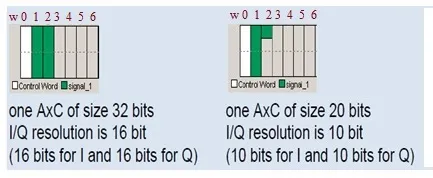
CPRI AxC Examples
Here are a couple of cases illustrating how AxCs are used:
Case 1: Basic Frame Transmission at 3.84 MHz
The basic frames are transmitted over the CPRI link at a fixed clock rate of 3.84 MHz. This means a new basic frame is sent every 0.26 µs. The required data rate dictates how many AxCs are needed per basic frame to carry the I/Q data.
For instance, with a 3GPP signal having a sample rate of 3.84 MHz, only one AxC is needed per basic frame. Every 0.26 µs, a basic frame is transmitted, carrying one AxC, i.e., one I/Q sample. This results in an I/Q data rate of 3.84 MHz over the CPRI link.
Case 2: Signal with Sample Rate of 11.52 MHz
In this case, you’d need three AxCs per basic frame to handle the higher sample rate. Again, a basic frame is transmitted every 0.26 µs, but this time it contains three AxCs, representing three I/Q samples. The resulting I/Q data rate over the CPRI link becomes 3.84 MHz * 3, which equals 11.52 MHz.