
What is Dwell Time and Hop Time in LoRaWAN/LoRa
Advertisement
Dwell time and hop time are important parameters in LoRaWAN and frequency hopping communication systems. Dwell time refers to how long a transmitter stays on a frequency channel, while hop time defines the interval between frequency changes. These parameters influence regulatory compliance, interference mitigation and network performance. This page explains definitions of dwell time and hop time in the context of LoRaWAN and LoRa technology.
Introduction
Both dwell time and hop time are related to the chirp spread spectrum (CSS) modulation technique, which is fundamental to LoRa. CSS employs wideband, linear frequency-modulated chirp pulses to encode baseband information. This technology is favored in space and military communications due to its characteristics: long range, low transmit power, and resilience to interference.
Dwell Time
Dwell time, sometimes referred to as transmit time, represents the duration for which a LoRa radio transmits on a specific frequency. In simpler terms, it’s the time the radio “dwells” on a particular frequency while sending data.
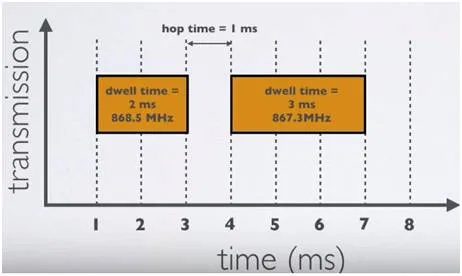 Dwell time vs Hop time
Hop Time
Hop time, conversely, is the time required for the radio to switch from one frequency to another. Crucially, the radio does not transmit during this hop time. It’s a transition period between active transmissions on different frequencies.
Continue Learning LoRaWAN Technology
- LoRa Basics Tutorial
- LoRaWAN Network Architecture
- LoRaWAN Protocol Stack
- LoRaWAN Physical Layer
- LoRaWAN MAC Layer
- LoRa Channel to Frequency Conversion
- LoRaWAN Frequency Bands
- LoRaWAN Classes
- LoRaWAN Interface Types