
What is DVB-S2X : Advantages and Disadvantages
Advertisement
DVB-S2X is an extension of the DVB-S2 standard that delivers higher spectral efficiency, improved modulation schemes, and better support for broadband satellite applications. It is widely used in high-throughput satellite systems. Advantages include increased capacity and performance, while disadvantages include greater implementation complexity and compatibility considerations.
DVB-S2X incorporates numerous new features compared to previous versions. Its common applications include DTH (Direct To Home), VSAT, DSNG, 5G cellular services, and mobile applications. DVB-S2X maintains backward compatibility with DVB-S2. The ETSI EN 302 307-2 (part-2) document details the specifications of DVB second generation, covering frame structure, channel coding, and modulation.
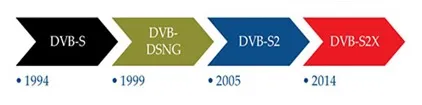 DVB-S Evolution Timeline
DVB-S2X, similar to DVB-S2, utilizes LDPC and BCH as inner and outer code FEC (Forward Error Correction) techniques.
Key Features of DVB-S2X
- Increased granularity in modulation/coding modes
- Filter roll-off factors of 5%, 10%, 20%, 25%, and 35% are supported
- Supports QPSK, 8PSK, 8/16/32 APSK, 64/128/256 APSK
- Channel bonding up to 3 channels
- New constellations designed for linear and nonlinear channels
- Super Frame option
- Supports 116 MODCODs, up to 256 APSK 11/15, three frame sizes (normal, short, medium)
- Enhanced scrambling options for mitigating co-channel interference
Benefits or Advantages of DVB-S2X
The following are the benefits and advantages of DVB-S2X:
- It supports very low C/N (Carrier-to-Noise Ratio), typically down to -10dB.
- It allows the use of smaller antennas due to technological advancements.
- It offers an efficiency gain of up to 51% compared to DVB-S2.
- Improved filtering capabilities enable smaller carrier spacing.
- Channel bonding facilitates the combination of multiple carriers to enhance efficiency for UHD TV services.
- Scrambling options help to counteract co-channel interference.
Drawbacks or Disadvantages of DVB-S2X
The following are the drawbacks and disadvantages of DVB-S2X:
- Similar to DVB-S2, the implementation complexity is higher than the DVB-S standard.
- The upgrade process presents challenges due to the extensive deployment of DVB-S standard devices worldwide.
- DVB-S2X devices are more expensive compared to DVB-S2 and previous versions.
- The DVB-S2X standard largely retains the DVB-S2 main architecture with some modifications, rendering it non-backward compatible with the DVB-S2 standard.
Summary
DVB-S2X improves satellite network efficiency through advanced transmission techniques. Advantages include higher throughput and flexibility, while disadvantages include increased system complexity.
Continue Learning DVB (Digital Video Broadcasting)
Explore the global standards for transmitting digital television over satellite, cable and terrestrial networks.
- DVB-T vs DVB-S vs DVB-C vs DVB-H: Understanding the Differences
- DAB vs DVB vs DMB (Digital Multimedia Broadcasting)