
What is DNA Data Storage : Advantages and Disadvantages
Advertisement
DNA data storage is an emerging technology that encodes digital information into synthetic DNA molecules for ultra high density, long term data preservation. It offers remarkable storage capacity and durability compared to conventional media. Advantages include exceptional density and longevity, while disadvantages include high costs, slow access speeds, and complex encoding processes.
The demand for digital data storage is skyrocketing due to the immense amount of data generated on the internet. DNA-based data storage offers a potential solution to meet these ever increasing requirements. DNA provides a robust, sustainable, and stable data storage medium, boasting a storage density significantly higher than current technologies.
DNA encoding and decoding Process
DNA data storage involves encoding binary data into synthetic, man-made DNA strands. The process consists of:
- Writing the code via DNA synthesis.
- Reading the code via DNA sequencing.
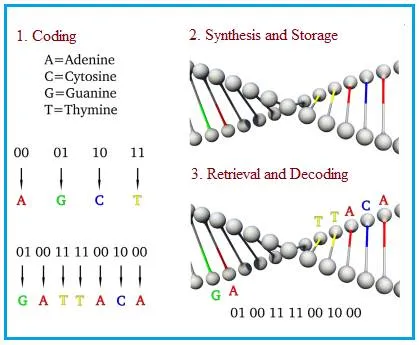
Image Courtesy: POTOMAC INSTITUTE FOR POLICY STUDIES
The figure illustrates the entire process of encoding digital data into DNA and decoding it back.
- To store a binary file in DNA, binary digits (1s and 0s) are converted into the letters A, C, G, and T. These letters represent the four unique nucleotides that comprise DNA: adenine, cytosine, guanine, and thymine.
- The physical storage medium is a synthesized chain of DNA containing As, Cs, Gs, and Ts in a sequence corresponding to the order of bits in a digital file.
- To retrieve the stored data, the DNA chain is sequenced, and the order of As, Cs, Gs, and Ts is decoded back into the original digital sequence.
Benefits or Advantages of DNA Data Storage
Here are the key advantages of DNA data storage over traditional media storage methods:
- Scalable, Random-Access, and Error-Free: DNA offers a potentially scalable, random-access, and highly accurate data storage system.
- High Storage Density: Its storage density is orders of magnitude greater than existing storage technologies. For instance, flash memory stores 1 bit in approximately 10 nanometers, while DNA can store 2 bits in 0.34 nanometers.
- Long Lifespan: DNA is remarkably stable and can last for thousands of years, unlike magnetic, optical, and flash methods. DNA molecules have a half-life of over 500 years.
- Lightweight: It is exceptionally light.
- Compact Size: It requires minimal space to store vast amounts of data.
- High Data Security: It offers a very high level of data security during storage.
Drawbacks or Disadvantages of DNA Data Storage
Despite its promise, DNA data storage also has several drawbacks:
- High Cost: DNA synthesis relies on organic chemistry, making DNA synthesis currently very expensive.
- Slow Access Time: Accessing data is time-consuming. The DNA sample must be sent to a lab for sequencing to read the data stored as DNA code letters (‘A-00’, ‘T-01’, ‘C-10’, and ‘G-11’). New technologies are needed to accelerate DNA data access.
- Storage Requirements: Synthetic DNA needs to be stored in cold and dark conditions.
- Maturity of Technology: The technology is still developing, and inexpensive devices for everyday use are not yet available.
- Original Purpose: DNA was initially developed for life science applications, not data storage. Therefore, achieving commercial viability for DNA data storage products remains a challenge.
Summary
DNA data storage uses synthetic DNA to archive digital information with unprecedented density. Advantages include long-term preservation and massive capacity, while disadvantages include cost and retrieval challenges.
Continue Learning Data Storage, Integrity & Compression
Explore how data is compressed, protected, and stored—from traditional data centers to cutting-edge DNA storage.
- Data Center: Advantages and Disadvantages
- Data Protection: Advantages and Disadvantages
- Data Integrity: Advantages and Disadvantages
- Data Compression: Advantages and Disadvantages
- Lossless vs Lossy Data Compression
- Text-Based Data Compression Algorithms
- Data Deduplication Explained
- Data Fusion: Advantages and Disadvantages
- Data Brokering: Advantages and Disadvantages
- DNA Data Storage Companies
- Mass Data Surveillance (COVID-19)