
What is Scrambling in Data Communication: Advantages and Disadvantages
Advertisement
Scrambling in data communication is a signal processing technique that modifies bit patterns to eliminate long sequences of identical bits without changing the transmitted information. Its advantages include improved synchronization and reduced electromagnetic interference, whereas its disadvantages include additional processing requirements and increased system complexity.
Scrambler circuit used in WiMAX Physical Layer
Scrambling is the process of randomizing binary data. A scrambler is the logic circuit that performs this randomization. Typically, it’s a linear feedback shift register (LFSR) with an EX-OR gate, as shown below:
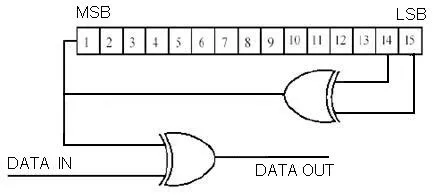
The primary goal of scrambling is to remove long strings of consecutive 1s or 0s from the digital binary data stream. This is crucial for synchronization. Scramblers are implemented in the physical layer of the transmitter, while corresponding descramblers are used at the receiver.
Importantly, scrambling neither increases nor decreases the bit rate. The input and output bit streams have the same size. By eliminating long strings of identical bits, scrambling introduces more level transitions in the data pattern, aiding in receiver synchronization.
There are two main types of scramblers:
- Additive (Synchronous) Scramblers: These use modulo-two addition (EX-OR) as depicted in the figure above.
- Multiplicative (Self-Synchronizing) Scramblers: These perform multiplication of the input signal by the scrambler’s transfer function in the z-domain.
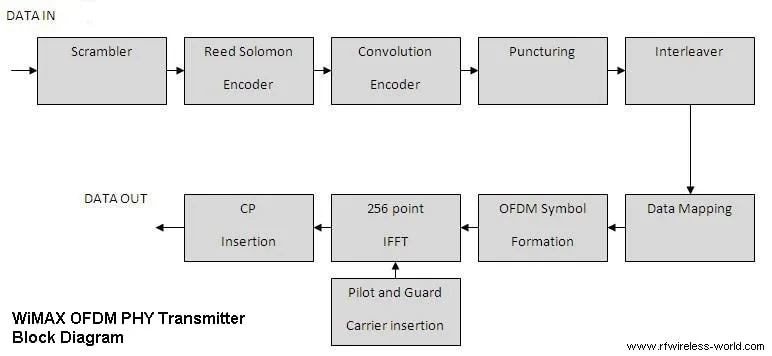
Scrambling is often used in conjunction with other modules in the physical layer, such as Forward Error Correction (FEC) encoders (e.g., Convolutional, Reed-Solomon, CTC), interleavers, and data modulation techniques. It’s also combined with block coding techniques like 4B/5B or 8B/10B to enhance performance.
Benefits (Advantages) of Scrambling in data communication
- No Increase in Data Rate: Unlike block coding, scrambling doesn’t increase the data rate. This makes it an efficient method for data manipulation without bandwidth overhead.
- Improved Synchronization: By eliminating long strings of 0s and 1s, scrambling introduces more transitions in the data stream. This significantly helps the receiver synchronize and accurately recover the original bit pattern.
- Elimination of DC Components: Scrambling helps balance positive and negative voltage levels during the encoding process in line coding techniques like R8ZS and HDB3, effectively eliminating DC components from the signal.
- Error Detection Capability: Certain scrambling techniques can offer some level of error detection capability, although this isn’t their primary function.
Drawbacks (Disadvantages) of Scrambling in data communication
- Error Multiplication (Multiplicative Descramblers): Multiplicative descramblers can produce error multiplication. A single bit error at the input can propagate and cause multiple errors in the descrambled data. Therefore, they are often used with other FEC techniques for error correction.
- Error Propagation (Additive Scramblers): Additive scramblers must be reset by a “frame sync” signal during descrambling. Failure to do so can result in massive error propagation throughout the decoded data.
- Limited Randomness: Under specific worst-case conditions, both types of scramblers can fail to produce truly random sequences. This limitation can affect their performance in certain applications.
MATLAB Code Example
Here’s an example of MATLAB code for a scrambling circuit, as per IEEE 802.16 WiMAX OFDM physical layer specifications:
Scrambler_input=[80 255 16 9 48 255 80 0 25 0 145];
s=20255;  %Initialization of scrambler circuit
rand_data=zeros(size(Scrambler_input));
for j=1:size(Scrambler_input,2);
    for i=1:8
        msb=bitxor(bitget(s,1),bitget(s,2));
        s=bitshift(s,-1);
        s=bitset(s,15,msb);
        t=bitxor(bitget(Scrambler_input(j),9-i),msb);
        rand_data(j)=bitset(rand_data(j),9-i,t);
    end
end
scrambler_out=rand_data
Summary
Scrambling improves digital communication reliability by maintaining signal transitions, reducing timing errors and minimizing transmission related interference. Its communication advantages enhance data integrity across high speed networks, although encoder decoder implementation adds processing overhead.