
PCSEL vs VCSEL: Key Differences in Surface Emitting Lasers
Advertisement
Introduction : Semiconductor lasers are widely used in modern photonics systems including optical communication, sensing, imaging, and industrial automation. Among these devices, Vertical Cavity Surface Emitting Lasers (VCSELs) and Photonic Crystal Surface Emitting Lasers (PCSELs) represent two important classes of surface-emitting semiconductor lasers.
Both technologies emit laser light perpendicular to the chip surface, enabling compact packaging, wafer level testing, and easier integration with optical systems. However, they differ significantly in their optical cavity design, beam characteristics, power scaling capability and application domains.
This guide compares VCSEL and PCSEL technologies to help engineers understand when each laser type is best suited for a particular optical system.
VCSEL Overview
A Vertical Cavity Surface Emitting Laser (VCSEL) uses a short optical cavity formed between two highly reflective mirrors called Distributed Bragg Reflectors (DBRs). These mirrors are composed of alternating semiconductor layers with different refractive indices. The cavity length is typically only a few micrometers.
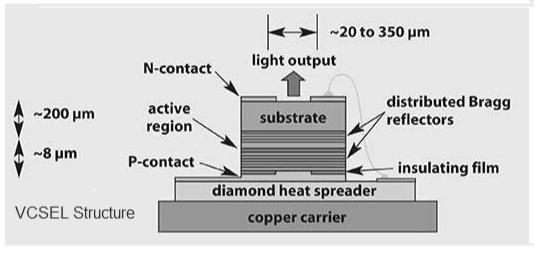
The figure-1 shows basic structure of VCSEL. It consists of top metal contact, distributed bragg reflector, active quantum well region, distributed bragg reflector and substrate.
The benefits of VCSELs include low threshold current, circular beam profile, easy array fabrication, high modulatio speed, low manufacturing cost etc. Due to these advantages, VCSELs are widely used in consumer electronics and short range communication systems.
PCSEL Overview
A Photonic Crystal Surface Emitting Laser (PCSEL) uses a two dimensional photonic crystal structure instead of conventional mirrors to form the laser cavity.
The photonic crystal is a periodic pattern embedded within the semiconductor material that controls light propagation through diffraction and interference.
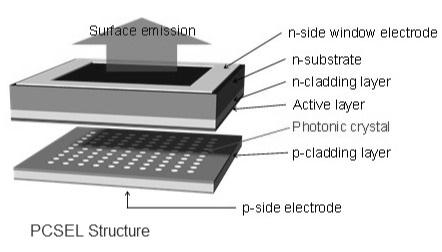
The figure-2 shows basic structure of PCSEL. It consists of top contact, photonic crystal layer, active gain region and substrate.
The benefits of PCSEL include high beam brightness, large coherent emission area, narrow beam divergence, high single mode output power, excellent beam quality etc. Due to these advantages, PCSEL technology is considered promising for high power optical systems such as LiDAR and industrial lasers.
Key difference between PCSEL and VCSEL
Following table compares VCSEL vs. PCSEL technologies.
| Feature | VCSEL | PCSEL |
|---|---|---|
| Resonator Structure | Distributed Bragg Reflectors | Photonic crystal lattice |
| Beam Emission | Vertical | Vertical |
| Beam Quality | Good | Excellent |
| Power Scaling | Moderate | Very High |
| Mode Control | Limited for large devices | Strong due to photonic crystal |
| Fabrication Complexity | Mature Process | More Complex nanofabrication |
| Typical Wavelength | 850 to 940 nm common | Wide wavelength flexiblity |
Summary
VCSEL and PCSEL technologies both represent important advancements in semiconductor laser design. While VCSELs offer mature manufacturing, low cost and high speed modulation suitable for consumer devices and optical communication, PCSELs provide superior beam quality and higher power capability for demanding applications such as LiDAR and industrial processing.
Tags
Advertisement


