
What is Coolant Sensor : Advantages and Disadvantages
Advertisement
A coolant sensor measures the temperature of engine coolant and provides data to the vehicle’s engine control unit for optimal performance and safety. It is widely used in automobiles and industrial machinery. Advantages include improved engine efficiency, while disadvantages include sensor failures and calibration-related issues.
Introduction:
- A coolant sensor functions as a temperature sensor, much like a thermistor.
- It’s an NTC (Negative Temperature Coefficient) type sensor.
- When the coolant temperature increases, its resistance decreases. Conversely, when the coolant temperature decreases, its resistance increases.
- It’s typically located on the cylinder head of the engine.
- It’s used to control the cooling fan of the engine, turning it on or off, and to activate emission controls.
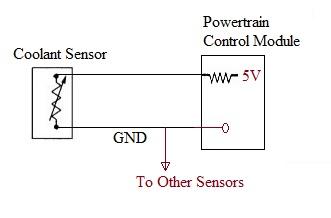
Image Alt: Coolant Sensor Connection Diagram
Advantages of Coolant Sensors
Following are the benefits of using coolant sensors:
- Engine Overheat Protection: They protect engines in cars and other vehicles from overheating.
- Simple Measurement: They only require a two-wire measurement of resistance in ohms.
- Fast Response: They provide a quick response to temperature changes.
- High Sensitivity: They are very sensitive and offer a significant output change based on the input temperature.
- Accuracy: They are more accurate compared to RTDs (Resistance Temperature Detectors) and thermocouples.
- Cost-Effective and Compact: They are inexpensive and available in small sizes.
Disadvantages of Coolant Sensors
Following are the drawbacks of using coolant sensors:
- Limited Temperature Range: They have a restricted temperature range in which they can operate effectively.
- Current Source Required: They require a current source for operation.
- Fragility: They are fragile and can be easily damaged.
- Non-Linear Output: The output is a non-linear function, which can complicate data interpretation.
- Self-Heating: They are prone to self-heating, which can affect accuracy. To minimize self-heating error, it’s essential to limit the sensing current to a lower value.
Summary
Coolant sensors monitor engine temperature for efficient operation and protection. Advantages include improved performance and fuel economy, while disadvantages include maintenance and reliability concerns.
Advertisement


