
What is Cellular Network : Advantages and Disadvantages
Advertisement
A cellular network is a wireless communication system divided into geographic cells, each served by a base station. It enables voice, data, and multimedia services for mobile devices. Advantages include mobility and wide coverage, while disadvantages include network congestion, infrastructure costs, and dependence on signal availability.
About Cellular Network
Modern wireless networks like GSM, CDMA, and LTE are known as cellular networks. These networks divide a geographic area into smaller “cells.” Each cell uses radio frequencies to connect mobile subscribers for voice and data services.
Within each cell is a base station (BTS, eNodeB, or eNB). These base stations are interconnected in various topologies (star, mesh, etc.) and are linked to core network elements like MSCs (Mobile Switching Centers), PSTN (Public Switched Telephone Network), and PSDN (Packet Switched Data Network) in the backbone.
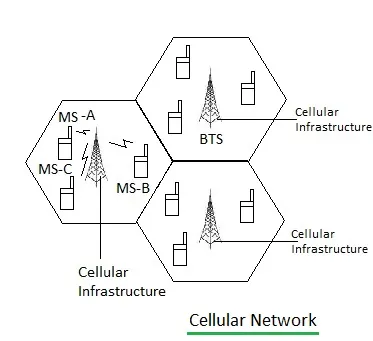
Macrocells can cover areas up to 20 Km, while microcells have a smaller range, typically up to 1 Km. Multiple subscribers can connect to a single base station through multiple access techniques such as TDMA, FDMA, or CDMA.
Advantages of Cellular Networks
- Mobility: Cellular networks provide voice and data services even while roaming. This allows you to stay connected almost anywhere within the network’s coverage area.
- Connectivity: They connect both traditional landline (fixed) and wireless phone users, bridging the gap between different communication methods.
- Wireless Infrastructure: Cellular is ideal for areas where laying cables is impractical or impossible due to terrain or cost.
- Ease of Maintenance: The infrastructure is generally straightforward to maintain compared to wired networks.
- Easy Upgrades: Upgrading equipment is a relatively simple process.
- Instant Connection: Mobile and fixed subscribers connect almost instantly. As soon as a mobile phone is switched on, the necessary “handshake” signals are automatically exchanged between the phone and the base station.
Disadvantages of Cellular Networks
- Lower Data Rates: Compared to wired networks like fiber optics or DSL, cellular networks typically offer lower data rates. The exact speed varies depending on the specific wireless standard (GSM, CDMA, LTE, 5G, etc.).
- Multipath Signal Loss: Macrocells are susceptible to multipath signal loss, where radio waves reflect off objects, causing interference and signal degradation.
- Limited Capacity: The capacity of a cell is limited and depends on the number of channels and multiple access techniques used to serve subscribers. Overcrowding can lead to slower speeds and dropped connections.
- Security Vulnerabilities: As communication occurs over the air, cellular networks are inherently vulnerable to security breaches and eavesdropping.
- High Infrastructure Cost: Setting up a cellular network infrastructure requires significant investment.
- Environmental Interference: Wireless communication can be affected by physical obstructions (buildings, trees), climatic conditions (rain, fog), and interference from other wireless devices.
- Antenna Installation Challenges: Installing antennas for cellular networks requires space, foundation towers, and careful planning. This process can be time-consuming and require significant effort.
Summary
Cellular networks provide mobile voice and data connectivity across large geographic areas. Advantages include mobility and scalability, while disadvantages include coverage gaps and network congestion.