
CDSK Transmitter and Receiver with Chaos Signal
Advertisement
Chaos signals in CDSK (Correlative Differential Shift Keying) transmitters and receivers offer several unique characteristics:
- Non-periodicity: The signal doesn’t repeat in a predictable pattern.
- Broadband signal: It occupies a wide range of frequencies.
- Non-predictability: It’s difficult to forecast the signal’s future values.
- Easy implementation: Relatively straightforward to generate and use.
This communication system relies on an initial vector generated using a chaos signal generator, as illustrated below:
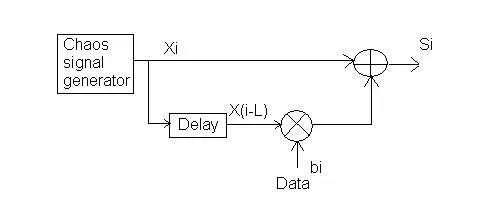
CDSK is a modulation technique used to modulate and transmit information bits (‘bi’). Unlike many communication systems, the CDSK transmitter doesn’t transmit a preamble. This leads to lower overhead, but also a poorer Bit Error Rate (BER) in noisy channel environments.
A preamble is a known bit pattern transmitted along with the data frame in many communication systems. At the receiver, this preamble helps in correlation, identifying the start of the frame, and front-end synchronization. Examples of systems using preamble-based transmissions include WiMAX, WLAN, and LTE.
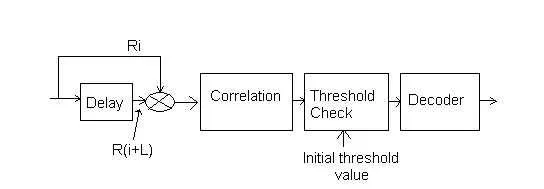
In a CDSK transmitter, the same signal is delayed and transmitted. Correlation is then done using the original signal and its delayed version. A threshold is determined based on the sum and average of the received signal samples. This threshold is used to find the start of the frame, and then the decoding process is employed.
To improve the BER, Space-Time Block Coding (STBC) based MIMO (Multiple-Input Multiple-Output) techniques can be used in CDSK systems. Common configurations include 2x1, 2x2, and 4x4 MIMO, depending on the requirements.
Continue Learning Modulation Types
- AM Vs. FM Vs. PM : Difference between Analog Modulation Techniques
- ASK Vs. FSK Vs. PSK : Difference between Digital Modulation Techniques
- PAM Vs. PWM Vs. PPM : Difference between Pulse Modulation Techniques
- BPSK Vs. QPSK : Key Differences
- 16-QAM Vs. 64-QAM Vs. 256-QAM : Key Differences
- 512-QAM Vs. 1024-QAM Vs. 2048-QAM Vs. 4096-QAM
- 4096QAM Modulation Used in Wi-Fi 7
- MSK Vs. GMSK : Modulation Technique used in GSM
- LORa Modulation Used in LoRaWAN
- 10% ASK & 100% ASK Modulation used in NFC
- OOK Vs. VPPM Vs. CSK : Visible Light Communication (VLC) Modulation Techniques
- QPSK Vs. OQPSK Vs. PI/4 QPSK
- PAM4 Modulation Used in Gigabit Ethernet
- CCK Vs. DSSS Vs. OFDM Used in WLAN (Wi-Fi) Standards