
What is a Brouter in Networking : Advantages and Disadvantages
Advertisement
A brouter is a hybrid networking device that combines the functions of both a bridge and a router. It routes routable protocols while bridging non-routable traffic. Advantages include network flexibility and protocol support, while disadvantages include increased complexity and reduced popularity in modern network architectures.
How does Brouter Work?
A Brouter is a network device that combines the functionalities of both a bridge and a router. It’s employed in networks encompassing LANs, MANs, and WANs.
As we know, a bridge converts signals from one physical transmission medium to another or from one protocol format to another. Bridges operate at the data link layer (Layer 2) of the OSI model, reading the MAC address of devices. A bridge typically has only two ports.
A router, on the other hand, routes data based on routing algorithms to forward packets between devices. Routers handle internet traffic over the WAN and keep local traffic within the LAN. Routers operate at the network layer (Layer 3) of the OSI model, reading the IP address of a device and generally possess more ports than bridges.
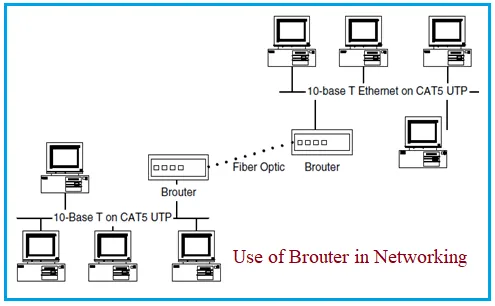
The image above illustrates an application example of a brouter in a network. It shows a brouter converting electrical signals to optical signals and vice versa to transmit/receive data over fiber optic cables. This allows an Ethernet-based LAN to interface with a distant LAN using fiber.
Essentially, a brouter aims to provide the best features of both bridges and routers, operating at both the data link and network layers.
Advantages of a Brouter
- Optimal Data Routing & Reduced Network Traffic: It determines the best route for data packets, reducing overall network traffic. This leads to a more efficient internet connection as it transmits and receives only relevant traffic, rather than all traffic on the network.
- Packet Filtering and Switching: Brouters support both packet filtering and packet switching.
- LAN and WAN Compatibility: They can be used in both local area networks (LANs) and wide area networks (WANs).
- NAT Support & Enhanced Security: A Brouter can be configured to use Network Address Translation (NAT), hiding the real IP addresses of the internal network and improving security.
- Connectivity with Different Mediums: They facilitate connections between different network mediums.
Disadvantages of a Brouter
- Cost: Brouters are generally more expensive than hubs and routers.
- Complexity: They are more complex to manage and require a significant amount of initial configuration.
- Inherited Disadvantages: Consider the disadvantages of bridges and the disadvantages of routers as they apply to the brouter’s operation.
Summary
A brouter combines routing and bridging functions in one device. Advantages include versatility and protocol support, while disadvantages include complexity and limited modern usage.
Continue Learning Core Networking : TCP, IP & UDP
- OSI vs TCP/IP Models
- Understanding TCP/IP Packet Format
- TCP vs UDP: Key Differences
- TCP vs MPTCP (Multipath TCP)
- IPv4 vs IPv6
- MPLS Label Switching vs IP Packet Switching
- Non-IP Networking: Working, Protocols & Benefits