
What is BLE : Bluetooth Low Energy Advantages and Disadvantages
Advertisement
Bluetooth Low Energy (BLE) is a wireless communication technology designed for low-power applications such as wearables, IoT devices, sensors, and healthcare equipment. Advantages include minimal power consumption and wide compatibility, while disadvantages include limited data rates and shorter communication range compared to some wireless technologies.
Introduction to BLE
- Bluetooth specifications are developed and maintained by the Bluetooth SIG (Special Interest Group).
- The IEEE standardized Bluetooth as IEEE 802.15.1, but they no longer maintain the standard. There are various Bluetooth versions, from V1.2 to V4.1, V4.2, V5.0, and V5.1 (the most recently published).
- Bluetooth Low Energy (BLE) refers to Bluetooth specifications V4.1 and above.
- BLE operates in the license-free 2.4 GHz frequency band. It has 40 channels in total, with 3 used for advertising and 37 for data transmission/reception.
- It covers a distance of about 50 meters indoors and 150 meters outdoors.
- It employs GFSK modulation.
- Data rates vary depending on the Bluetooth version. BLE v4.1 supports 1 Mbps, while the latest V5.1 supports 2 Mbps.
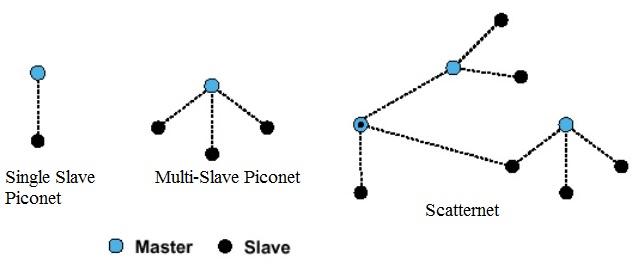
- There are two types of network topologies in Bluetooth: piconet and scatternet.
- A piconet consists of 1 master and 1 slave, or 1 master and multiple slaves.
- A scatternet is a combination of multiple piconets.
- A device can participate in multiple piconets, timesharing and synchronizing with the master of the current piconet.
In BLE, devices function in different role pairs:
- Advertiser/Scanner (Initiator)
- Slave/Master
- Broadcaster/Observer
BLE devices play various roles during the discovery/connection phases in Uni-cast (peer-to-peer) or Broadcast connections.
Advantages of BLE (Bluetooth Low Energy)
The following are the benefits of BLE:
- Low Power Consumption: Offers very low power consumption, resulting in long battery life. This is because both master and slave devices can enter deep sleep mode between transactions. The master informs the slave about the hopping sequence and when to wake up.
- Suitable for Small Data Transfers: Ideal for small data transfers, especially in IoT (Internet of Things) applications. It offers a maximum message capacity of up to 255 bytes.
- Security: Provides security using 128-bit AES algorithms. Encryption is applied to data communicated between master and slave devices.
- Interference Resistance: Uses frequency hopping in the 2.4 GHz band, making it resistant to interference. Advertising channels are chosen to be different from WiFi channel frequencies to avoid interference between WiFi and Bluetooth devices.
- Robustness in Congested Environments: BLE devices are robust in congested environments due to the introduction of V5.0.
- Reliability: Offers reliability and enhances digital life.
- BLE Beacons: BLE beacon devices have become popular due to the increased speed and range in Bluetooth 5.0.
- Fast Connection and Data Transfer: Connection establishment and data transfer are very fast (about 3 ms).
- Interoperability: Devices from different manufacturers are compatible with each other.
- Inexpensive and Widely Available: There are countless BLE devices available, and they are generally inexpensive.
Disadvantages of BLE (Bluetooth Low Energy)
The following are the drawbacks of BLE:
- Lower Data Rates: Cannot be used for higher data rates compared to WiFi and cellular technologies. It supports 1 Mbps & 2 Mbps data rates.
- Limited Range: Cannot be used for long-distance wireless communication unlike cellular and WiFi devices. Supports up to 200 meters in LOS (Line of Sight).
- Security Risks: Vulnerable to interception and attacks due to wireless transmission/reception.
Summary
BLE enables energy-efficient wireless communication for IoT and wearable devices. Advantages include low power consumption and affordability, while disadvantages include limited throughput and range.
Tags
Advertisement


