
What is WSN : Wireless Sensor Network Advantages and Disadvantages, Types
Advertisement
A Wireless Sensor Network (WSN) consists of distributed sensor nodes that monitor environmental or physical conditions and communicate wirelessly with a central system. Its advantages include remote monitoring and scalable deployment, whereas its disadvantages include limited battery life, constrained processing capability, and security challenges. There are two major types of WSN viz. stationary and mobile.
WSN Architecture and its types
A Wireless Sensor Network (WSN) comprises end sensor nodes, routing nodes, and a base station or data collector sink node (also known as a base station or gateway). For a WSN to be effective, it needs to be both scalable and secure, ensuring efficient and reliable network performance.
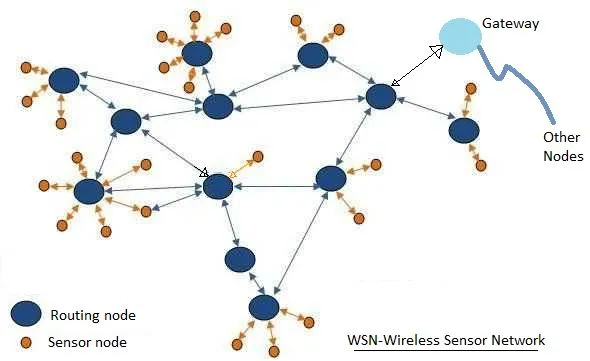
WSNs can be categorized based on various factors, including network type, clustering method, communication protocol, application area, and coverage range.
At its core, a WSN consists of spatially distributed autonomous sensing devices. These devices are designed to monitor physical or environmental conditions like temperature, pressure, sound, vibration, motion, or pollutants at different locations.
Communication between nodes in a WSN is wireless, adhering to various routing protocols. WSNs typically operate in environments with constrained bandwidth and performance. They are often self-organizing, multi-hop ad hoc networks.
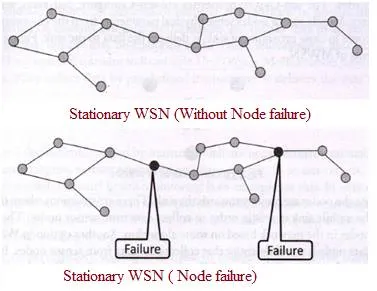
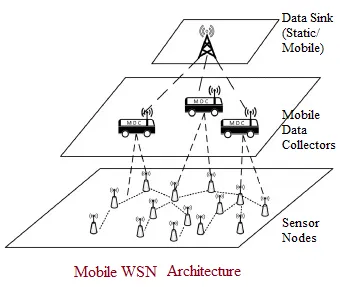
WSNs can be broadly classified into two main types: stationary and mobile. For more detailed information, you can refer to articles specifically on WSNs.
Benefits or Advantages of WSNs
- Scalability: WSNs are scalable, allowing you to add new nodes or devices at any time without significant disruption.
- Flexibility: They offer flexibility and can adapt to physical partitions, making them suitable for diverse environments.
- Centralized Monitoring: All nodes within the WSN can be accessed through a centralized monitoring system, simplifying management.
- Wireless Operation: Being wireless, WSNs eliminate the need for extensive wiring or cabling.
- Wide Applicability: WSNs can be deployed on a large scale and are applicable across various domains, including mines, healthcare, surveillance, and agriculture.
- Security: WSNs incorporate different security algorithms depending on the underlying wireless technologies, providing a reliable network for users.
Drawbacks or Disadvantages of WSNs
- Security Vulnerabilities: Due to their wireless nature, WSNs are susceptible to hacking.
- Limited Speed: They aren’t suited for high-speed communication as they are designed for low-speed applications.
- Cost: Building and deploying WSNs can be expensive, making them potentially unaffordable for some users or applications.
- Design Challenges: There are various challenges in WSN design, including energy efficiency, limited bandwidth, node costs, deployment models, and hardware/software constraints.
- Single Point of Failure: In star topology-based WSNs, the failure of the central node can bring down the entire network.
Summary
Wireless sensor networks enable efficient real time monitoring and data collection for industrial automation, environmental monitoring, healthcare, agriculture, and smart infrastructure. WSNs can be designed using various topologies such as star, tree, mesh, and hybrid.