
What is f-OFDM : Advantages and Disadvantages
Advertisement
Filtered Orthogonal Frequency Division Multiplexing (f-OFDM) is an enhanced multicarrier modulation technique designed for 5G wireless networks. It applies sub-band filtering to improve spectral efficiency and reduce interference between services. Advantages include flexible spectrum utilization and lower out-of-band emissions, while disadvantages include increased processing complexity and filter design challenges.
f-OFDM Transmitter and Receiver Block Diagram
As mentioned, f-OFDM is short for Filtered Orthogonal Frequency Division Multiplexing. It’s a variation of the conventional OFDM technique.
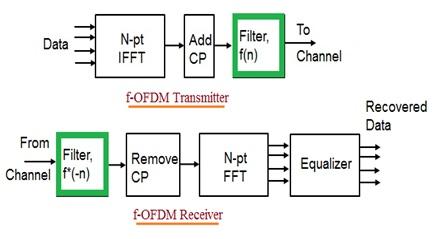
Figure 1: f-OFDM Transmitter and Receiver
Figure 1 depicts the use of a filtering algorithm after the IFFT/CP module in a normal OFDM transmit chain.
Advantages of f-OFDM
f-OFDM offers all the advantages of OFDM, such as flexible frequency multiplexing, simple channel equalization, and easy combination with multi-antenna transmission.
Following are the specific benefits of f-OFDM i.e. Filtered OFDM.
- Efficient utilization of spectrum: f-OFDM makes better use of the available frequency spectrum.
- Suppressed Out-Of-Band Emission: It reduces Out-Of-Band Emission, minimizing the need for large guard bands.
- Optimized Numerology: Different numerologies can be applied to suit the needs of specific services within each sub-band. This allows for optimized performance for various applications.
- Incorporation of other Waveforms: It’s possible to integrate other waveforms such as GFDM, FBMC, UFMC, etc.
- Backward and forward compatibility: Supports compatibility with both older and newer technologies.
- Relaxed Synchronization Requirements: Using sub-band based filtering relaxes the global synchronization requirement, enabling inter-sub-band asynchronous transmission.
Disadvantages of f-OFDM - Filtered OFDM
Following are some of the limitations of f-OFDM.
- Additional Filters: f-OFDM requires an additional pair of transmit and receive filters in the transmitter and receiver chains compared to conventional OFDM, adding to complexity and cost.
- CP Requirement: Like OFDM, Cyclic Prefix (CP) is still needed in filter-based waveforms like UFMC and F-OFDM to protect the signal from Inter-Symbol Interference (ISI).
- ICI Presence: Full-band filtering cannot remove Inter-Carrier Interference (ICI), meaning it still exists in f-OFDM, similar to standard OFDM.
Summary
f-OFDM improves 5G spectrum efficiency by applying filtering to OFDM sub bands. Advantages include better interference control and flexible resource allocation, while disadvantages include implementation complexity and additional signal processing overhead.
Advertisement


