
Satellite Orbit Time Period Calculator & Formula
Advertisement
The satellite orbital period is the time it takes for a satellite to complete one full orbit around the Earth. It is determined by the satellite’s altitude and the Earth’s gravitational pull, following Kepler’s third law of planetary motion. The orbital period can be calculated using the distance from the Earth’s center to the satellite or the altitude of the satellite above the Earth’s surface.
Satellite Orbit Time Period
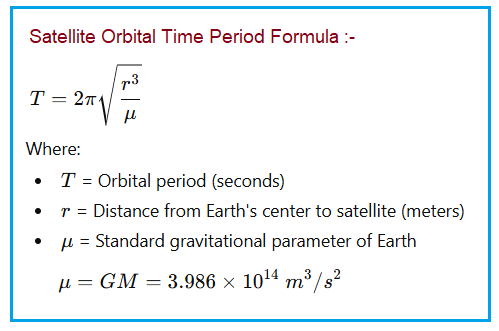
Following are the two formulas to calculate satellite orbital period based on Kepler’s third law of planetary motion:
- Using distance from Earth’s center to satellite (r) : T = 2π * sqrt(r^3 / μ)
- Using altitude of satellite above Earth’s surface (h) : T = 2π * sqrt((R + h)^3 / μ) Where :
- T = Orbital period (seconds)
- r = Distance from Earth’s center to satellite (meters)
- h = Altitude of satellite above Earth’s surface (meters)
- R = Radius of Earth (meters)
- μ = Standard gravitational parameter for Earth (m^3 s^-2) = G * M
- G = Gravitational constant (6.67430 x 10^-11 m^3 kg^-1 s^-2)
- M = Mass of Earth (5.972 x 10^24 kg) The orbital period (T) can be converted from seconds to minutes by dividing by 60.
Satellite Orbit Time Calculator
This calculator allows you to compute the orbital period of a satellite based on either the distance from Earth’s center or the altitude above Earth’s surface, providing insights into the time it takes for a satellite to complete one full orbit around the Earth.
Calculation Example-1 (Using Formula-1):
- Inputs : Distance from Earth’s center to satellite (r) = 6878 km,
- Outputs : Orbital period (seconds) = 5676.88 seconds, Orbital period (minutes) = 94.61 minutes
- Constants :
- Gravitational constant (G) = 6.67430 x 10^-11 m^3 kg^-1 s^-2,
- Mass of Earth (M) = 5.972 x 10^24 kg
- Standard gravitational parameter for Earth (μ) = G * M = 3.986004418 x 10^14 m^3 s^-2
Calculation Example-2 (Using Formula-2):
- Inputs : Altitude of satellite above Earth’s surface (h) = 500 km,
- Outputs : Orbital period (seconds) = 5676.88 seconds, Orbital period (minutes) = 94.61 minutes
- Constants :
- Gravitational constant (G) = 6.67430 x 10^-11 m^3 kg^-1 s^-2,
- Mass of Earth (M) = 5.972 x 10^24 kg
- Standard gravitational parameter for Earth (μ) = G * M = 3.986004418 x 10^14 m^3 s^-2
- Radius of Earth (R) = 6378 km
Conclusion
The satellite orbital period is a critical parameter for understanding the dynamics of satellite motion around the Earth. By using Kepler’s third law, we can calculate the orbital period based on either the distance from the Earth’s center or the altitude above the Earth’s surface. This information is essential for satellite mission planning, communication scheduling and optimizing the performance of satellite systems in various applications. Understanding the orbital period helps engineers and scientists design efficient satellite orbits for telecommunications, Earth observation and navigation purposes.
Advertisement


