
Microstrip Wavelength Calculator | RF PCB Tool
By RF Wireless Expert Team
Advertisement
This tool calculates the guided wavelength of a signal propagating through a microstrip line on a PCB.
What is Microstrip Wavelength?
The microstrip wavelength is the effective wavelength of an electromagnetic wave as it travels along a microstrip transmission line. It is influenced by the physical properties of the substrate material and the geometry of the microstrip line.
Microstrip Wavelength Calculator
EXAMPLE:
-
INPUTS:
- Frequency = 2.4 GHz
- Substrate Relative Permittivity (εr) = 4.4 (For FR4 substrate material)
- Trace Width (w) = 3 mm
- Substrate Height (h) = 1.5 mm
-
OUTPUT:
- Effective Relative Permittivity (εeff) = 3.34
- Guided Wavelength (λg) = 68.37 mm
Microstrip Wavelength Formula
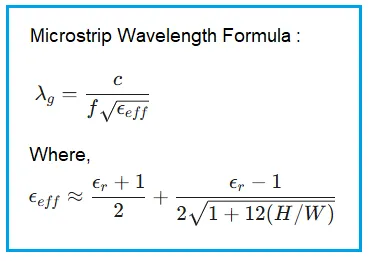
Where,
- λg = Guided Wavelength (mm)
- c = Speed of Light in Vacuum (approximately 3 x 10^8 m/s)
- f = Frequency (Hz)
- εeff = Effective Relative Permittivity of the Microstrip Line
- w = Width of the Microstrip Trace (mm)
- h = Height of the Substrate (mm)
key benefits
- Accurate Design: Helps in designing microstrip lines with precise wavelength characteristics.
- Optimized Performance: Ensures optimal signal integrity and performance in RF and microwave circuits.
- User-Friendly: Easy to use interface for quick calculations.
- Versatile Applications: Suitable for various PCB materials and configurations.
Applications
- RF and Microwave Circuit Design
- Antenna Design
- PCB Transmission Line Design
- High-Frequency Signal Integrity Analysis
References
- Pozar, D. M. (2011). Microwave Engineering (4th ed.). Wiley.
- Bahl, I. J., & Bhartia, P. (2003). Microstrip Lines and Slotlines (2nd ed.). Artech House.
- Gupta, K. C., Garg, R., Bahl, I. J., & Bhartia, P. (1996). Microstrip Lines and Slotlines. Artech House.