
iToF Distance Calculator | Indirect Time of Flight Formula
By RF Wireless Expert Team
Advertisement
This indirect time of flight (iToF) LiDAR distance calculator uses the phase shift of a modulated light wave to determine the distance to a target. By inputting the modulation frequency and measured phase shift, you can quickly calculate the range of your LiDAR sensor.
Example:
Input:
- Modulation Frequency, MHz: 20
- Measured Phase Shift in degrees: 60
Output:
- Distance of Target from LiDAR in meters: 1.25
Constant:
- Speed of Light (c): 3 x 10^8 m/s
iToF LiDAR Distance Formula
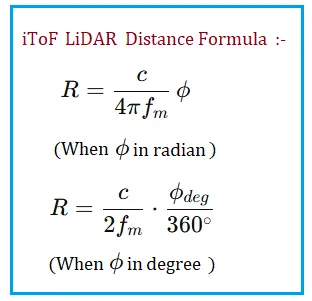
Where,
- d = Distance to target (meters)
- c = Speed of light (3 x 10^8 m/s)
- fm = Modulation frequency (Hz)
- phi = Measured phase shift (radians)
Applications/Benefits of iToF LiDAR Distance Calculation
- 3D Imaging: iToF LiDAR is ideal for creating detailed 3D maps of environments, making it useful for applications like virtual reality and gaming.
- Autonomous Vehicles: iToF LiDAR can provide accurate distance measurements for obstacle detection and navigation in self driving cars, especially in complex environments.
- Robotics: iToF LiDAR helps robots understand their surroundings and navigate by calculating distances to nearby objects with high precision.
- Industrial Automation: iToF LiDAR can be used in manufacturing and logistics for tasks like object detection, inventory management and quality control.
- Augmented Reality: iToF LiDAR enhances AR experiences by providing accurate distance measurements, allowing for better virtual object placement and interaction with the real world.
References for further study
- “Indirect Time of Flight (iToF) LiDAR Technology” - An in depth article explaining how iToF LiDAR works and its advantages over direct ToF.
- “Phase Shift Measurement in iToF LiDAR Systems” - A technical paper detailing the phase shift method for distance calculation in iToF LiDAR.
- “Applications of iToF LiDAR in 3D Imaging and Autonomous Vehicles” - A case study exploring real world uses of iToF LiDAR technology.
Explore More LiDAR Engineering Calculators
- LiDAR Distance Calculator and ToF Formula
- FMCW LiDAR Distance Calculator and Formula
- LiDAR Received Power Calculator and Formula
- LiDAR Point Density Calculator and Formula
- 3D LiDAR Point Coordinate Calculator and Formula
- Bathymetric LiDAR Depth Calculator and Formula
Continue Learning LiDAR Fundamentals & Types
- LiDAR Advantages and Disadvantages
- LiDAR as Target Detection and 3D Mapping/Imaging
- LiDAR 905nm vs 1550nm Differences
- Flash vs Scanning LiDAR Differences
- Mechanical Scanning vs Solid-State LiDAR Differences
- Single-Shot vs Multi-Shot LiDAR Differences
- dToF vs iToF LiDAR Differences
- Legacy vs Modern LiDAR Detectors Differences