
EVM Calculator & Formula with QPSK Example Vector Data
Advertisement
This EVM calculator allows you to compute the Error Vector Magnitude (EVM) of a QPSK modulation signal based on input I and Q vector data. EVM is a key performance metric in digital communication systems that quantifies the difference between the ideal transmitted signal and the actual received signal.
What is EVM ?
EVM is defined as the root mean square (RMS) of the error vector, which is the difference between the ideal constellation points and the actual received points in the I-Q plane. The formula for EVM is as follows:
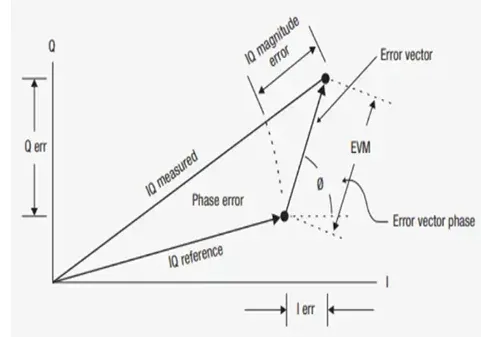
The error vectors are represented by the arrows connecting the ideal points to the actual points. The length of these arrows corresponds to the magnitude of the error vector, which contributes to the overall EVM calculation.
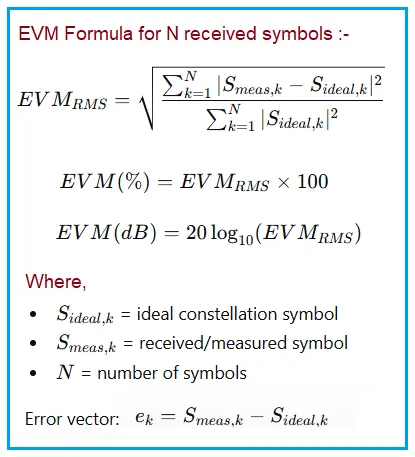
Where:
- EVM (RMS) is the root mean square of the error vector
- EVM (%) is the percentage of the error vector magnitude relative to the reference signal magnitude
- EVM (dB) is the EVM expressed in decibels
- Error Vector is the vector difference between the ideal constellation point and the actual received point in the I-Q plane
- Reference Signal Magnitude is the magnitude of the ideal constellation point (for QPSK, it is typically 1)
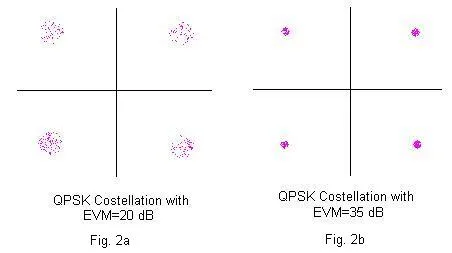
Lower EVM (EVM dB = -35 dB) values indicate better signal quality and higher fidelity in the received signal, while higher EVM (EVM dB = -20 dB) values indicate more distortion and degradation in the signal. The same has been illustrated in the constellation diagram above.
IDEAL QPSK Constellation Points
Following are the ideal constellation points for QPSK modulation in the I-Q plane. QPSK maps two bits of information to each symbol, resulting in four distinct constellation points as shown in constellation diagram as well as in the table below.
| Bits | Complex Value |
|---|---|
| 00 | 1 + j1 |
| 01 | -1 + j1 |
| 10 | 1 - j1 |
| 11 | -1 - j1 |
EVM Calculator for QPSK modulation data
Following example takes four symbols of QPSK I and Q vector data as input and calculates the EVM in RMS, percentage and dB.
EVM QPSK Calculation Example Valuespnp:
-
Inputs : Corrupt or noisy I/Q CSV File with the following data:
1.1,0.9 -0.8,1.1 -1.2,-0.9 0.9,-1.2 -
Outputs : EVM (RMS) = 0.1457, EVM (%) = 14.57 , EVM (dB) = -16.72 dB
Download Input CSV File for EVM Calculation
- Click to Download Sample I/Q CSV File
Conclusion
EVM is a critical parameter for assessing the performance of digital communication systems, especially in modulation schemes like QPSK, 16-QAM, 64-QAM, 256-QAM, 1024-QAM and 2048-QAM. Lower EVM indicates better modulation accuracy and better is the system performance. By analyzing the EVM, engineers can identify and mitigate issues such as noise, interference and distortion in the communication system, ultimately improving the overall signal quality and reliability. By using this EVM calculator, you can easily calculate the EVM of your QPSK modulation data and assess the quality of your communication system.