
Magnetron Calculator | Hull Cutoff & Hartree Potential formula
Advertisement
The magnetron is a high power microwave vacuum tube that operates as a self oscillating crossed field device. It employs mutually perpendicular electric and magnetic fields to control electron motion and generate microwave energy. It consists of a central thermionic cathode surrounded by a cylindrical anode structure containing resonant cavities. Due to its high efficiency, compact size and ability to generate kilowatt level microwave power, the magnetron is widely used in radar systems, industrial heating, medical applications, and microwave ovens.
Two critical voltage conditions namely the Hull Cutoff Potential and the Hartree Potential define the fundamental operating limits of a magnetron. This magnetron calculator tool calculates both the Hull cutoff potential and the Hartee potential for a magnetron. Magnetrons operate above Hull cutoff and below Hartree voltage.
EXAMPLE:
- INPUTS:
- Cathode radius = 0.0025
- Anode radius = 0.005
- Magnetic field = 0.27
- Frequency = 2.95
- Number of resonators = 8
- OUTPUTS:
- Maximum Hull potential = 22.5 KV
- Hartree potential = 11.7 KV
Magnetron Equation
As we know, tube devices used for microwave signal generation and microwave signal amplification can be broadly categorized into linear beam and cross-field devices. The Magnetron falls under the cross-field category.
The following equation or formula is used in the Magnetron calculator:
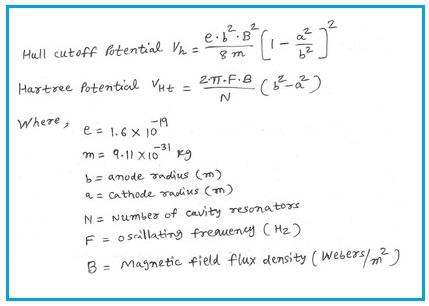
Hull Cutoff Potential: It is the minimum anode voltage at a given magnetic field for which an electron emitted from the cathode just fails to reach the anode. Below this voltage, electrons are returned to the cathode due to magnetic confinement.
Hartree Potential: It is the anode voltage at which electrons rotate synchronously with the RF wave in the magnetron cavities. This condition allows maximum energy transfer, leading to stable oscillation.
Summary:
Stable magnetron oscillation occurs only within the voltage range bounded by these two conditions, typically expressed as follows.
Operation outside this range leads to either electron confinement without RF generation or loss of synchronism and reduced efficiency.
Advertisement


