
Bluetooth Direction Finding Calculator : AoA and AoD
Advertisement
Bluetooth Direction Finding (introduced in Bluetooth 5.1) allows devices to determine the direction of a Bluetooth signal. This is achieved using two methods: Angle of Arrival (AoA) and Angle of Departure (AoD). While the hardware roles and packet structures differ between AoA and AoD, the underlying mathematical principles to calculate the angle from phase differences are identical. Below is the framework, formula, and Step-wise calculation to build a Bluetooth Direction Finding Calculator.
Bluetooth AoA and AoD Direction Finding Calculator
Scenario :
Let’s assume we are tracking a Bluetooth tag using a 2.44 GHz signal. The receiver has a two-antenna array.
INPUTS:
- Frequency = 2.44 GHz
- Antenna Spacing = 0.05 meters
- Measured Phase Difference = 60 degrees
OUTPUT:
- Angle of Arrival/Departure in degrees = 65.8
- Angle of Arrival/Departure in radians = 1.148
Result: The signal is arriving from (or departing at) an angle of 65.8 degrees relative to the line connecting the two antennas.
Bluetooth Direction Finding Using AoA & AoD Formula
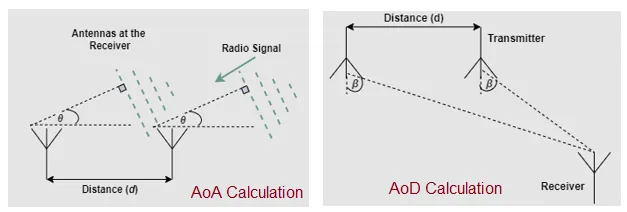
In both methods, the Bluetooth signal is transmitted as an unmodulated Continuous Wave (Constant Tone Extension, or CTE). The receiver samples the In-Phase and Quadrature (IQ) components of this wave to determine its phase. Because the signal arrives at (or departs from) multiple antennas at slightly different times, there is a phase difference between the antennas.
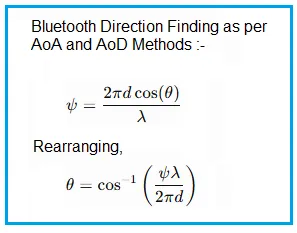
Where,
- = Angle of Arrival/Departure in radians (measured relative to the axis of the antenna array).
- = Measured phase difference between two antennas in radians. (Derived from IQ samples: , then ).
- = Wavelength of the Bluetooth signal in meters.
- = Distance between the two antennas in meters
Comparing AoA and AoD Approaches
Angle of Arrival (AoA)
- How it works: The transmitter (e.g., a small tracking tag) uses a single antenna to send the CTE. The receiver (e.g., a ceiling-mounted locator) has an antenna array. The receiver rapidly switches between its antennas while capturing IQ samples to measure the phase difference.
- Who calculates: The Receiver (Locator).
- Use Case: Asset Tracking / Item Finding. Tracking pallets in a warehouse, medical equipment in a hospital, or finding lost keys. The heavy computational work is done by the plugged-in infrastructure.
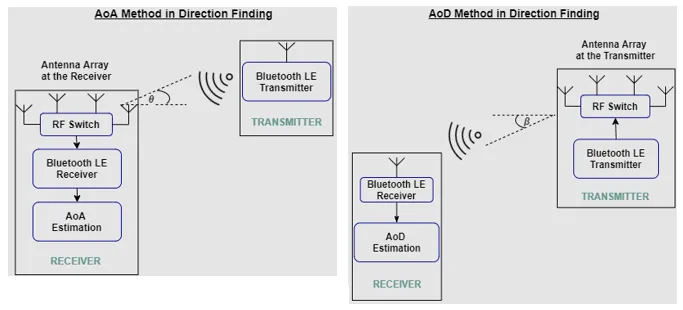
Angle of Departure (AoD)
- How it works: The transmitter (e.g., a fixed ceiling beacon) has an antenna array. It rapidly switches between its antennas while transmitting the CTE. The receiver (e.g., a smartphone) uses a single antenna to capture the IQ samples. Because the signal was transmitted from different spatial locations, the smartphone detects phase shifts.
- Who calculates: The Receiver (Smartphone).
- Use Case: Indoor Navigation / Wayfinding. A user’s smartphone receives signals from ceiling beacons to guide them through an airport or mall. The smartphone calculates its own position, ensuring user privacy (the infrastructure does not track the phone).
Explore More Bluetooth Calculators
- Bluetooth Range Estimation using RSSI Calculator
- Bluetooth Channel Sounding (CS) Ranging Calculator : Phase based Vs. RTT
- Bluetooth Location Tracking (Trilateration) Calculator
Continue Learning Bluetooth Basic Concepts
- What are new features in Bluetooth 6.3 Version
- Bluetooth GATT Vs. ATT Vs. GAP : Key Comparison
- Bluetooth Service Vs. Characteristic Vs. Descriptor
- Bluetooth Central Vs. Peripheral : Key Differences
- Bluetooth pairing Vs. Bonding Phase
- Bluetooth Notifications Vs. Indications
- Bluetooth Channel Sounding Vs. RSSI
- Bluetooth Direction Finding Methods : AoA Vs. AoD
- Bluetooth HID Over GATT
- Bluetooth IRK Vs. LTK : Key Differences
- Bluetooth PHY : 1M Vs. 2M Vs. Coded Differences
- What is ATT MTU Size in Bluetooth
- Bluetooth Ranging : Phase Based Vs. RTT Based
- Bluetooth Error Codes Guide : Meanings, Causes & Fixes
Continue Learning Bluetooth Technology
- Bluetooth Basics Tutorial
- Bluetooth Low Energy (BLE) Basics Tutorial
- Bluetooth Protocol Stack & Device State Diagram
- Bluetooth Physical Layer Modules
- Bluetooth MAC Layer Overview
- Bluetooth Channel Frequency List
- Bluetooth Network Security
- Bluetooth Low Energy (BLE) Connection Establishment Procedure
- Bluetooth Profiles: HFP, HSP, A2DP, AVRCP, PBAP & MAP
- Bluetooth Mesh Node Types & Protocol Stack Layer Functions