
Wireless Communication System and its components
Advertisement
A wireless communication system enables the transmission and reception of information without physical cables by using electromagnetic waves such as radio, microwave, or infrared signals. It consists of key components including a transmitter, receiver, antenna, communication channel, modulation unit and signal processing circuits. Wireless systems form the foundation of 4G/5G mobile networks, Wi-Fi, satellite communications, IoT and broadcasting services.
Introduction : Early wireless systems were developed for voice communication. Later, text based data transmission systems were introduced to support telegraphy, paging and low speed digital messaging services. With advancements in wireless technology, higher speed data communication became possible, enabling internet access, multimedia transmission, video streaming, machine-to-machine (M2M) communication, and IoT applications. Today, modern wireless communication systems support seamless voice, data, and video services across wireless networks with significantly improved capacity, coverage, reliability and spectral efficiency.
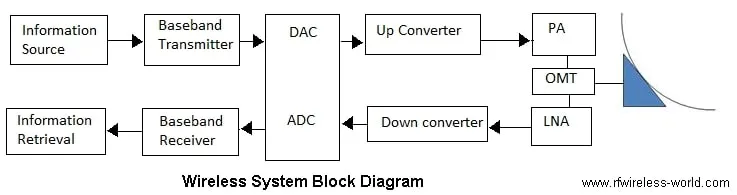
Wireless Communication System Block Diagram
The wireless system block diagram is composed of following components.
- Baseband
- RF
- A-D/D-A converters
Baseband Part
The baseband part mainly helps retrieve information correctly at the other end and makes it feasible to transmit through the channel. It consists of a Source Encoder, a Forward Error Correction module (CC or CTC), and a Baseband Modulator (BPSK, QPSK, 16QAM, 64QAM).
With the invention of higher order modulations such as 64QAM and 256QAM coupled with MIMO, much higher data rates are achieved. To ensure correction at the receiver in noisy channel environments, forward error corrections (FECs) have been devised. Various FEC techniques, such as convolution coding and convolution turbo coding, have been developed for this purpose.
A to D and D to A converters
It converts Digital data into Analog form at the Transmitter. The output is modulated IQ data at IF Frequency. This will be the input to RF Up converter. At receiver ADC is used which converts modulated IQ data at IF into digital data.
RF Part
It consists of an up converter/power amplifier at the transmitting end and an LNA / down converter at the receiving end. An antenna converts the signal into electromagnetic form and vice versa to Transmit/Receive the signal into the air. OMT makes it possible to use the same antenna for both transmit and receive. OMT is basically a transmit reject filter which blocks the signal to be transmitted while the Antenna is receiving the signal from the other end.
Two main parameters coverage distance and data rate are critical in designing a wireless system. The simplest way to achieve a greater distance or coverage is by transmitting higher power. Repeaters are also used in long distance communication before the signal is completely degraded and needs to be recovered.
Types of Wireless Networks
Wireless networks are divided based on user perspective parameters. The main characteristics that form types of networks are as follows. Various wireless standards and proprietary standards exist to define the specifications to be followed by manufacturers of wireless equipment to provide service to the community.
- Fixed OR Mobile
- Point to Point (PTP) OR Point to MultiPoint (PMP)
- Licensed OR Unlicensed
Fixed: This type of network has both source and destination fixed at one location. One example is a point-to-point (PTP) terrestrial microwave radio link. The other networks are WLAN and WiMAX based on 802.11 and 802.16 IEEE standards. Point-to-Point and Point-to-Multipoint networks in both licensed and unlicensed categories are available in the frequency range from 1GHz to about 90GHz.
Nomadic: These networks provide individuals with high-speed data access in many public and private places. They are not actually mobile networks, but some sort of mobility is permitted, such as when a person is walking or moving from one place to another. One such network is the 802.11b-based WiFi network.
Mobile: In this network, a higher speed of mobility is involved between the user and the base station of the wireless system providing the service. Usually, the base station is fixed, and mobile subscribers/PDAs/tablets/laptops will be moving through some means of transport. Examples of such systems are Mobile WiMAX (16e), WCDMA, GSM, LTE, LTE-Advanced, etc.
Types of Network Topologies
P2P Topology: In this topology, voice or data service is point to point (P2P). For example, between Access Point and Station directly in the case of a WLAN or WiFi network.
PMP Topology: In this topology, the service is point to multipoint (PMP). For example, between a base station and multiple subscribers or users in GSM, CDMA, LTE, and WiMAX networks.
Wireless Network Speeds
The following table mentions wireless network speeds/data rates, including major mobile broadband standards like WiMAX, GSM, CDMA, UMTS, LTE, LTE-a or LTE-Advanced, etc. As described earlier, speed depends on various parameters such as higher modulation schemes 64QAM/256QAM, multiple antenna techniques such as MIMO, and symbol duration/period.
| Wireless System/Standard | Data rate/Speed |
|---|---|
| WLAN 11a/11g (54Mbps) | 11b(5.5 and 11Mbps) |
| 11n | Max. Data rate: 600 Mbps with 40 MHz bandwidth and 4 streams |
| 11ac wave1 | Max.speed of 1.3Gbps(with 80MHz,3 stream and 256QAM) |
| 11ac wave2 | Max.speed of 3.5Gbps(with 160MHz,4 stream and 256QAM) |
| 11ad | 7Gbps |
| WiMAX | About 70Mbps in OFDM Upto 170 Mbps for high bandwidth/64QAM and MIMO |
| Zigbee | 20/40Kbps in 868-915MHz band 250Kbps in 2450MHz band |
| iBurst | Downlink-95Mbps and Uplink-36Mbps |
| GSM | 270 Kbps |
| GSM EDGE Evolution | 1.8944 Mbps in DL and 0.9472 in UL |
| GSM EDGE classic | 384 kbps |
| EVDO rel.0 | DL: 2.45,UL: 0.15 |
| EVDO rel.A | DL:3.1,UL:1.8 |
| EVDO rel.B | DL:4.9xN, UL:1.8xN ,N is the number of carriers with BW of 1.25MHz |
| UMTS /WCDMA/ HSPA+ | 168Mbps in downlink and 22Mbps in uplink |
| UMTS/ WCDMA / HSDPA | 14.4Mbps(DL),0.38Mbps(UL) |
| UMTS/WCDMA HSUPA | 14.4Mbps(DL), 5.76Mbps(UL) |
| CDMA2000 | 1.2288Mbps,3.6864Mbps |
| UMTS/TDD | about 16Mbps in DL/UL |
| LTE | Downlink: 300 Mbps, Uplink:75Mbps |
| LTE-a / LTE-Advanced | Downlink: 1Gbps,Uplink: 500 Mbps |
| HomeRF | Upto 10Mbps(2.4GHz band) |
| HiperLAN 1 / HiperLAN 2 | Upto 20 Mbps/54Mbps, used in 5GHz band/Europe |
| Bluetooth | 1Mbps, 2Mbps in 2.45GHz band |
| AMPS | 10Kbps |
| PCS(IS-54,IS-136) | 48Kbps |
| IS-95 | 1.2288Mbps |
| PDC | 42 Kbps |
| DECT | 1.152 Mbps |
| PHS | 384 Kbps |
| UMB | 480 Kbps |
Advanced techniques like beamforming are used to create more directional, focused antenna beam patterns. Higher data rates are achieved using higher modulation schemes such as 16QAM, 64QAM, and 256QAM. 16QAM carries 4 bits per carrier, 64QAM carries 6 bits per carrier, and 256QAM carries 8 bits per carrier. Furthermore, multicarrier systems based on OFDM modulation techniques have been developed, including WLAN, WiMAX, LTE, etc. Due to the simultaneous transmission of data over multiple carriers, higher data rates can be achieved using these OFDM/OFDMA techniques.
Summary
A wireless communication system transfers voice, data, video, and control signals through electromagnetic waves without wired connections. Its main components include the transmitter, receiver, antenna, communication channel, modulation and demodulation units and signal processing blocks. Understanding wireless communication system architecture helps in designing and optimizing cellular networks (e.g. 2G-GSM, 3G-UMTS, 4G-LTE, 5G-NR, 6G), Wi-Fi, Bluetooth, satellite communication, IoT devices, and modern wireless technologies.
Continue Learning Wireless Fundamentals & Core Concepts
- Wireless Communication Basics : Key Advantages & Disadvantages
- FDD vs TDD Difference in Wireless Communication
- FDMA Vs. TDMA Vs. CDMA : Key Differences
- Fading Basics and Types in Wireless Communication
- Interference Basics & Types
- Listen Before Talk Wireless Communication
- Wireless Propagation Modes
- Wireless Channel Models
- Wired Vs. Wireless Communication : Key Differences
Innovative Wireless Applications & Use Cases
- Top 10 Applications of Wireless Technology
- Wireless Charging standards : Qi & NFC
- Wireless Electricity Transmission Basics
- Medical Telemetry & RF Wireless Technologies
- V2V vs V2I: Vehicular Wireless Communication
- Wireless Cloud Surveillance Systems
- Underwater Wireless Communication Systems
- Optical Wireless Network Communication
- Satellite & Mobile Communication : Key differences