
6G NTN Security: Protecting Satellites, HAPS and UAVs
Advertisement
Introduction : As we know 6G network architecture consists of LEO/GEO Satellites, High Altitude Platform Stations (HAPS), and Unmanned Aerial Vehicles (UAVs) to provide global coverage. However, this massive footprint creates a massive attack surface. A satellite signal covers hundreds of kilometers, making it easy for adversaries to eavesdrop.
Physical Layer Security (PLS) provides a robust, keyless defense for these space and aerial networks, focusing on two distinct communication modes viz. Radio Frequency (RF) and Free Space Optical (FSO).
To understand the security dynamics, we must identify and categorize altitude layers as per NTN components used.
- Satellites (LEO, MEO, GEO): Operating from 500 km to 36,000 km. They provide wide coverage but suffer from high latency and path loss.
- HAPS (The Stratosphere Layer): Drones or balloons stationed approx. 20 km high. They act as “super macro base stations,” bridging the gap between satellites and the ground. They are quasi stationary and sit above the clouds, avoiding much of the atmospheric turbulence that plagues satellites.
- UAVs (Low Altitude): Drones flying closer to the ground, used for temporary coverage or relaying.
Let us understand defense mechanism incorporate in physical layer to offer security to RF links and FSO links in 6G for different NTN players.
Securing RF Links
Radio Frequency (RF) is the standard for satellite to ground communication. Its biggest weakness is its broadcast nature; anyone with a dish in the satellite’s footprint can listen in.
In NTN, RF signals undergo “Shadowed Rician fading” which is a mix of direct line of sight (LoS) and random fluctuations caused by obstacles like buildings or mountains. Eavesdroppers on the ground can exploit these fluctuations to intercept data when the legitimate user is in a poor signal reception area.
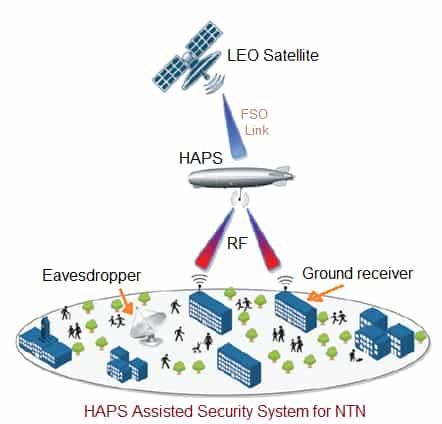
The direct link from Satellite to a Ground Station is long and vulnerable to interception over a huge area. In 6G, there is solution for this, with the help of using HAPS as a secure relay. In this proposed solution, the Satellite beams data to a HAPS node using a tight laser link (FSO), and the HAPS relays it to the ground using RF.
Because the HAPS is closer to the ground, the RF footprint is smaller and more controllable. This architecture increases the Secrecy Capacity by ensuring the legitimate link is mathematically superior to the eavesdropper’s link.
Securing FSO links
Free Space Optical (FSO) communication uses lasers to transmit data. While generally more secure than RF because the beam is narrow, it is not immune to hacking.
Threat of beam wandering and pointing errors : In the stratosphere or space, platforms vibrate. This causes Pointing Errors, where the laser beam jitters or drifts off target. If the beam drifts, “side lobes” or scattered light can spill over to a nearby adversary (e.g. rogue satellite or spy drone flying near the receiver). Moreover, factors like wind speed and temperature changes cause the air to act like a lens, scattering the laser. Attackers can collect this scattered light to steal data without physically blocking the beam.
Solutions : Physical layer security (PLS) strategies for FSO in NTN focuses on geometry and hardware.
- Aperture Averaging: Using larger receiver apertures (i.e. lenses) allows the legitimate node to capture more of the fluctuating beam, maintaining a high signal to noise (SNR) ratio that an eavesdropper with a smaller receiver cannot match.
- Zenith Angle Optimization: The angle at which a ground station looks up at a HAPS/Satellite matters. A lower zenith angle (i.e. looking straight up) reduces the amount of turbulent atmosphere the beam travels through, minimizing scattering and leaving less “spilled data” for eavesdroppers to collect.
Summary
| Scenario | Threat involved | Defense incorporate in physical layer to deliver security |
|---|---|---|
| Space to HAPS | An Eavesdropping Spacecraft flies near the LEO satellite to catch side lobe transmissions. | Utilize the vacuum of space (no turbulence) to use ultra-narrow beams that are geometrically impossible for the nearby attacker to intercept without blocking the link. |
| HAPS to UAV | A Rogue UAV hovers near a legitimate drone receiving data from a HAPS. | Exploiting the high altitude of HAPS to create steep look-angles, minimizing the “spillover” area on the ground or in the air where a rogue drone could hide. |
| Satellite to Ground | Ground Eavesdroppers intercept wide area RF broadcasts. | Artificial Noise Injection: The satellite transmits noise into the specific geographic zones where eavesdroppers are suspected, blinding them while keeping the legitimate ground station clear. |
Summary: By understanding how atmospheric turbulence, pointing errors and orbital geometry affect signal propagation, engineers can design Physical Layer Security (PLS) protocols that ensure data stays secure even when it is beamed from 500 km above the Earth.
Tags
Advertisement


