
Constellation Rotation in 6G: Enhancing Wireless Security
Advertisement
Introduction : Constellation Rotation is a digital signal processing technique where the constellation points of a modulation scheme (like QPSK or QAM) are rotated by a specific angle in the complex plane. In the context of 6G wireless, this technique is evolving from a simple reliability tool into a critical enabler for Physical Layer Security (PLS), Non Orthogonal Multiple Access (NOMA) and Integrated Sensing and Communication (ISAC).
What is Constellation Rotation ?
In standard modulation, data symbols (i.e. constellation points) are mapped to fixed positions on the I/Q (In-phase/Quadrature) plane. In constellation rotation, these points are shifted phase wise by an optimal angle as shown in the figure.
The constellation rotation concept was used traditionally before 6G era to ensure that information is recovered even if one component is lost due to fading. In 6G, this rotation is often dynamic, user specific or secured by key to confuse eavesdroppers or optimize interference between multiple users.
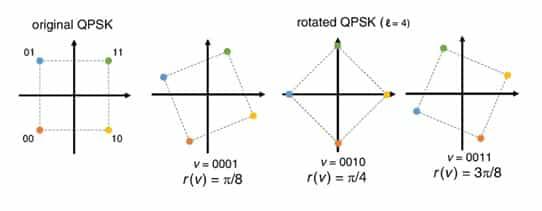
Key usage in 6G Wireless
- Physical Layer Security (PLS) : 6G networks aim to provide “native security” at the physical layer, reducing reliance on upper layer encryption for low latency applications. Constellation rotation is a primary tool for this purpose.
- In one approach, reference signals are rotated with secret phase angle known to both legitimate transmitter (Say Allen) and receiver (Say Bilal). The eavesdropper can not distinguish between actual channel phase shift and artificial rotation. Hence eavesdropper (Say Eva) tries to decode the data but her equalization fails resulting in high error rates.
- In massive MIMO systems, specific symbols are rotated such that they add up constructively at legitimate receiver. At eavesdropper which is at different location, these symbols combine destructively and appear as random noise.
-
Enhancing NOMA : As NOMA uses same frequency resource to serve multiple users, there should be some way to distinguish signals of different users. This is done by having different rotation angles of constellation points for different users.
-
Integrated Sensing and Communication : In this feature, radio waves are used to both send data and “sense” the environment similar to radar. In this dual functionality, constellation rotation can be used to modulate the “sensing” waveform.
-
SWIPT (Simultaneous Wireless Information and Power Transfer) : Research indicates that rotating constellations in multi user transmission can maximize the constructive interference at the energy harvesting receiver (increasing peak to average power ratio (PAPR) for better harvesting) while maintaining signal integrity for the information receiver.
Summary: By dynamically altering symbol phases, it provides a robust, lightweight mechanism for Physical Layer Security that scrambles signals against eavesdroppers while simultaneously enhancing spectral efficiency in Non-Orthogonal Multiple Access (NOMA) scenarios. Ultimately, its ability to embed data into sensing waveforms and optimize interference makes it an indispensable tool for realizing the secure, Integrated Sensing and Communication (ISAC) architectures of the future.
Advertisement


