
PCSEL Surface Emitting Laser: Working, Design & Applications
Advertisement
Among emerging semiconductor laser technologies, the Photonic Crystal Surface Emitting Laser (PCSEL) has gained significant attention due to its ability to deliver high optical power, narrow beam divergence, and excellent beam quality in a compact semiconductor device.
Unlike conventional semiconductor lasers that emit light from the edge of the chip, PCSEL devices emit light perpendicular to the wafer surface. This design allows easier integration into optical systems and enables high power coherent emission across a large device area.
What is PCSEL ?
A Photonic Crystal Surface-Emitting Laser (PCSEL) is a semiconductor laser that uses a two-dimensional photonic crystal structure to control light propagation and generate coherent laser emission from the surface of the chip.
A typical PCSEL device consists of the following layers:
- Substrate : semiconductor base (commonly GaAs)
- Active gain region : quantum wells that generate - photons through stimulated emission
- Photonic crystal layer : periodic nanostructure providing optical feedback
- Current injection electrodes
- Optical output surface
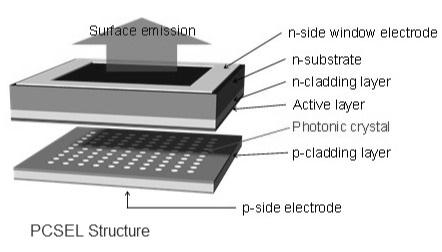
The photonic crystal layer forms a two dimensional optical resonator. When electrical current is injected into the active region, stimulated emission occurs and the photonic crystal structure couples the optical mode vertically, producing the output beam.
Working of PCSEL
Following step wise guide describes PCSEL working.
-
An electrical current is applied across the device. Electrons and holes recombine in the active region, producing photons.
-
The photonic crystal structure forms a distributed feedback resonator. Bragg diffraction inside the periodic structure traps photons within the plane of the crystal.
-
Higher order diffraction couples the resonant optical mode vertically, allowing the laser beam to exit from the surface of the device.
Because the resonator extends over a large area, the device can produce high power single mode emission while maintaining good beam quality.
Advantages of PCSEL
Following are some of the benefits of PCSEL.
- High output power
- High beam quality
- Compact and Efficient
- Multiple PCSEL emitters can be fabricated on a wafer to create high-power laser arrays.
Conclusion
Photonic Crystal Surface-Emitting Lasers represent an important advancement in semiconductor laser technology. By integrating photonic crystal structures within the laser cavity, PCSEL devices achieve high brightness, excellent beam quality and scalable output power while maintaining compact size and efficiency.
These capabilities make PCSEL lasers highly suitable for modern optical systems such as LiDAR, industrial manufacturing and high speed optical communication.
Advertisement


