
What is Rhombic Antenna: Advantages and Disadvantages
Advertisement
A rhombic antenna is a large directional wire antenna consisting of four long conductors arranged in a diamond shaped configuration for high frequency communication. Its advantages include high gain and wide bandwidth, while its disadvantages include large installation space requirements and relatively lower efficiency without proper termination.
Rhombic Antenna Structure & Radiation Pattern
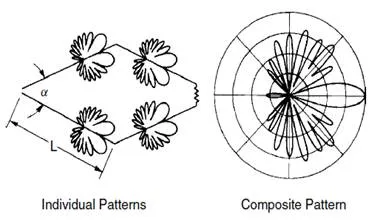
- The Rhombic antenna consists of two V-antennas, where the second V-antenna merges the two sides back together. This design allows for connecting balanced lines to a single terminating resistor.
- Using a single terminating resistor eliminates the grounding issues associated with V-antenna terminations during transmission.
- The figure below illustrates the radiation patterns of individual radiator elements and the combined radiation pattern of the rhombic antenna in the horizontal plane.
- A terminating resistor value of approximately 600 Ohms is typically used. The input impedance of the antenna ranges from 600 to 900 Ohms over an octave bandwidth. Input impedance depends on frequency, load resistor, and height.
- This antenna operates in HF (High Frequency) and VHF (Very High Frequency) bands, typically from 3MHz to 300MHz.
- Rhombic antennas find use in applications such as HF communications, point-to-point communication, and long-distance sky wave propagation.
Benefits or Advantages of Rhombic Antennas
- It’s easy to connect multiple rhombic antennas together.
- It provides effective transmission.
- The design is simple and straightforward.
- Input impedance and radiation pattern remain relatively constant.
- Rhombic antenna design eliminates grounding problems found in V-antenna terminations.
Drawbacks or Disadvantages of Rhombic Antennas
- Power is wasted in the terminating resistor. The load absorbs almost half of the transmitter power.
- It requires a large physical space.
- Transmission efficiency is reduced.
Summary
Rhombic antennas provide reliable long distance HF communication through high directional gain and broad frequency coverage. Their performance advantages have supported international broadcasting and military communication, although physical size and installation requirements limit their practical deployment.