
What is Lead Acid Battery : Advantages and Disadvantages
Advertisement
Lead acid batteries are rechargeable energy storage devices widely used in automobiles, UPS systems, and backup power applications. They offer proven reliability and low manufacturing costs. Advantages include affordability and high surge current capability, while disadvantages include heavy weight, lower energy density, and shorter lifespan compared to newer battery technologies.
Features and construction of Lead Acid Battery
- A battery is a device that stores electrical power.
- As shown in Figure 1, a lead acid battery typically contains six cells, each producing approximately 2V.
- The materials used in a lead acid battery are lead peroxide (PbO2), sponge lead (Pb), and dilute sulfuric acid (H2SO4).
- The positive plate is made of PbO2, a dark brown, hard, and brittle substance.
- The negative plate is made of pure lead in a soft, sponge-like condition (Pb).
- The electrolyte is H2SO4, with a water to acid ratio of approximately 3:1.
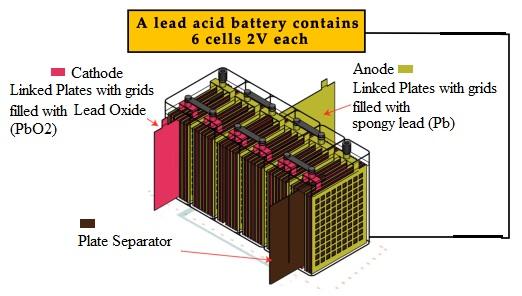
Lead Acid Battery construction
Advantages of Lead Acid Batteries
Here are the benefits of using lead acid batteries:
- Wide Availability: They are available in various shapes and sizes to suit different applications.
- Low Maintenance: They generally don’t require much maintenance.
- Reliable Performance: They are known for their reliability and consistent working capabilities.
- Charge Tolerance: They can withstand slow, fast, and even overcharging to some extent.
- Inactivity Tolerance: They can withstand long periods of inactivity, with or without a solvent.
- Cost-Effective: They offer the best value in terms of power and energy per KWH.
- Long Lifespan: They are known for their long life cycle.
- Recyclable: Approximately 97% of the lead in these batteries can be recycled and reused in new batteries.
- Inexpensive to Manufacture: They are simple and inexpensive to manufacture, resulting in a low cost per watt-hour.
- Low Self-Discharge: They have a low self-discharge rate, which is among the lowest for rechargeable batteries.
- Temperature Performance: They offer good performance at both low and high temperatures.
Disadvantages of Lead Acid Batteries
Here are the drawbacks of using lead acid batteries:
- Heavy Weight: Lead is a relatively heavy element compared to alternatives, making the batteries bulky.
- Low Specific Energy: They have a low specific energy, resulting in a poor weight to energy ratio.
- Slow Charging: They charge relatively slowly; a full charge can take 14 to 16 hours.
- Storage Requirements: They must be stored in a charged condition to prevent sulfation, which can damage the battery.
- Limited Cycle Life: They have a limited cycle life, and repeated deep cycling can significantly reduce battery life.
- Watering (Flooded Batteries): Flooded versions of lead acid batteries require periodic watering to maintain electrolyte levels.
- Environmental Concerns: They are not environmentally friendly due to the lead and sulfuric acid content.
- Transportation Restrictions: There are transportation restrictions on flooded-type lead acid batteries due to the risk of spillage.
Summary
Lead acid batteries provide economical energy storage for automotive and backup systems. Advantages include low cost and reliability, while disadvantages include weight, maintenance needs, and lower energy density.
Advertisement


