
What is Flash Memory : Advantages and Disadvantages & Types
Advertisement
Flash memory is a non-volatile storage technology that retains data without power and supports electronic erasing and rewriting. It is widely used in SSDs, USB drives, smartphones, and embedded systems. Advantages include fast access and compact storage, while disadvantages include limited write endurance and performance degradation over time.
Key Features of Flash Memory
Flash memory is a type of non-volatile storage, meaning it retains data even when the power is off. It’s commonly found in devices such as smartphones, USB drives, digital cameras, and SSDs, thanks to its speed, durability, and compact size.
Flash memory works using transistors that trap electrons to store binary data as 0s and 1s. This storage technology is particularly valued for its fast read and write capabilities, low power consumption, and the ability to be reprogrammed. It’s a type of EEPROM (Electrically Erasable Programmable Read Only Memory) chip that relies on a key device called a floating gate transistor for its operation.
Think of pen drives and small memory cards – these are common examples. There are two main types of flash memory: NAND flash and NOR flash. Other examples include USB flash drives and solid-state drives.
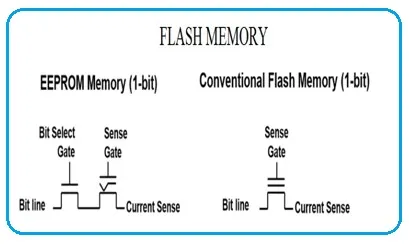
Types of Flash Memory
-
NOR Flash: This type provides fast read speeds and allows random access to any memory location, much like RAM. It’s often used where code storage and execution are necessary, such as firmware in embedded systems. NOR flash is slower for writing and erasing data, but it’s reliable and ideal for read-intensive applications.
-
NAND Flash: Known for its high storage density, NAND flash is optimized for fast write and erase speeds. It’s commonly used in consumer devices like USB drives and SSDs, where large data storage and efficient data transfer are needed. NAND flash might be less durable than NOR, but its lower cost per gigabyte and high-speed performance make it ideal for data storage.
These two types of flash memory have paved the way for modern storage solutions, balancing speed, durability, and storage capacity in a wide range of electronic devices.
Advantages of Flash Memory
Here are some of the key advantages of flash memory:
- Data Retention Without Power: Flash memory is non-volatile, preserving data even when the power is off.
- Large and Increasing Capacity: Flash memory offers substantial and growing storage capacities.
- High Transfer Speed: Flash memory has faster read and write speeds compared to traditional hard disk drives.
- Small Size and Portability: Its compact size makes it ideal for portable devices.
- Low Power Consumption: Flash memory consumes less power than traditional hard disk drives.
- Quiet Operation: It operates more quietly than physical hard drives.
- Damage Resistance: Flash memory is less prone to physical damage due to its solid-state nature.
- Cost-Effective at Smaller Capacities: Cheaper compared to traditional drives in small storage capacities.
- No Moving Parts: It doesn’t have any moving parts larger than electrons, which increases reliability.
Disadvantages of Flash Memory
Here are some of the disadvantages of flash memory:
- Higher Price Per Megabyte: The cost per megabyte is generally higher compared to traditional hard disks.
- Limited Write Cycles: Flash memory cells wear out after a certain number of write/erase cycles, typically between 10,000 and 1 million.
- Easy to Lose: Its small size makes it easy to misplace.
- Special Software Requirements: May require special versions of programs to avoid prematurely wearing out the drive.
- Expensive Writing Operations: Writing data (changing from 1 to 0) is a relatively expensive operation.
- Very Expensive Erasing Operations: Erasing data (changing from 0 to 1) is even more expensive.
- Read Disturb: Reading data can disturb nearby cells, limiting the number of consecutive reads to the same cell.
Summary
Flash memory provides non volatile data storage for modern electronic devices. Advantages include portability and speed, while disadvantages include finite write cycles and long term wear issues.